Epstein Remark Triggers LS Row As Rahul Warns On Energy Crisis

Rahul Gandhi's remarks, which included allegations linking Union petroleum minister Hardeep Singh Puri to deceased American financier and convicted sex offender Jeffrey Epstein, triggered a major uproar in the House (File Photo)
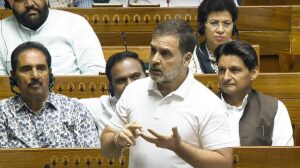
Rahul Gandhi, the Leader of Opposition in the Lok Sabha, on Thursday accused the government of compromising India’s energy security during a heated exchange in Parliament. His remarks, which included allegations linking Union petroleum minister Hardeep Singh Puri to deceased American financier and convicted sex offender Jeffrey Epstein, triggered a major uproar in the House and ultimately forced Speaker Om Birla to cut short Gandhi’s speech.
Gandhi had risen to raise concerns about India’s energy situation in the context of escalating tensions in West Asia. Speaking in the House, he argued that India’s ability to independently manage its energy needs had been weakened.
“The foundation of every single nation is its energy security,” Gandhi said. “I do not say this lightly, but allowing the United States to decide who we buy oil from, who we buy gas from, whether we can buy oil from Russia or not, whether our relationships with different oil suppliers can be decided by us, this is what has been bartered.”
According to Gandhi, India’s energy security was increasingly vulnerable due to developments in the region, particularly the disruption of shipping routes in the Gulf. Referring to the strategically vital Strait of Hormuz, he warned that the consequences for India could be severe if the situation worsened.
“The central artery from where 20 per cent of the global oil flows, the Strait of Hormuz, has been closed,” Gandhi said. “This will have tremendous repercussions for us because a very large portion of our oil and natural gas comes through the Strait of Hormuz.”
He added that the economic effects of the disruption were already beginning to be felt in some places.
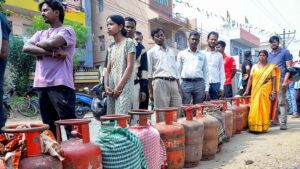
“The pain has just started,” Gandhi said. “Restaurants are closing, there is widespread panic about LPG, street vendors are affected. This is only the beginning.”
During his speech, Gandhi also questioned what he described as India’s dependence on external approval when purchasing oil, particularly from Russia. He referred to the temporary waiver granted by the United States that allowed India to continue importing Russian crude under certain circumstances.
“This is a very puzzling fact for me,” Gandhi said. “Why a nation the size of India would allow any other nation, the President of another nation, to give us permission to buy Russian oil, decide who our relationships are with.”
Gandhi then suggested that he had come to a conclusion about what he believed was the reason behind this situation. “I have been trying to figure this puzzle out,” he said. “And I have figured this puzzle out. The puzzle is about compromise.”
At this point, Gandhi turned toward the treasury benches and pointed toward Petroleum Minister Hardeep Singh Puri while speaking in the House. “We have a gentleman sitting here who is the oil minister,” Gandhi said. “He himself has said that he is a friend of Epstein.”
The reference to Jeffrey Epstein, who died in 2019 while awaiting trial on federal sex trafficking charges in the United States, immediately sparked loud protests from members of the ruling party. Treasury bench MPs rose from their seats and objected to Gandhi’s remarks, creating a noisy scene in the chamber.
Speaker Om Birla intervened quickly and asked Gandhi to avoid referring to Epstein, reminding him that the discussion was meant to focus on concerns about LPG supply and energy issues. “You should not refer to Epstein,” Birla told Gandhi. “You must speak only on the subject for which you have given notice.”
However, Gandhi insisted that his remarks were relevant to the broader question of India’s economic and energy security. “I am talking about economic security,” he said. “Here I have a document which shows that his daughter has received money from George Soros.”
This comment triggered another wave of protests from treasury bench MPs, who objected strongly to the allegations. As the shouting intensified, the Speaker ruled that Gandhi could not raise issues that were outside the scope of the notice he had submitted to speak in the House.
“I have said in the morning also that the House runs according to rules,” Birla said. “The notice that was given — you speak on that. If you wanted to speak on this issue, you should have given notice. I would have decided whether to allow it or not.”
Opposition members protested loudly after Gandhi’s speech was cut short. When Petroleum Minister Hardeep Singh Puri later stood up to respond, some opposition MPs raised slogans.
Several members were heard shouting, “Epstein, Epstein,” while others chanted, “Dekho dekho kaun aaya, Epstein ka dost aaya” (see who has come, Epstein’s friend has come).
Despite the disruptions, Puri proceeded with his response and delivered a statement lasting around 14 minutes. The minister sought to reassure the House that India’s fuel supplies remained stable and that there was no disruption to LPG deliveries.
According to Puri, India’s crude oil imports and domestic LPG supply chains were functioning normally. He said that the government had taken steps to ensure that households would not face shortages and that delivery schedules across the country remained intact.
The disruptions forced Speaker Om Birla to adjourn the House briefly before proceedings resumed later in the day. Once the session restarted, the Lok Sabha continued with discussions on the supplementary demand for grants.
Speaking to reporters outside Parliament later, Rahul Gandhi reiterated his concerns and warned that India needed to prepare for potential disruptions to its energy supply.
“Gas and fuel are going to be a problem because our energy security has been compromised,” he said. “A flawed foreign policy has created this problem.” He added that the government needed to act quickly to prevent economic hardship for ordinary citizens.
“Now what we have to do is to prepare,” Gandhi said. “Otherwise crores of people will suffer massive losses.” Gandhi also argued that the conflict in West Asia was part of a larger shift in global geopolitics.
“This war is fundamentally about the current world order,” he said. “We are going into an unstable time. When you are going into an unstable time you have to change your mindset.”
The Congress leader further stated that he had sought permission to make a detailed statement in Parliament regarding the LPG shortage issue but was not allowed to complete his remarks.
Meanwhile, Union Parliamentary Affairs Minister Kiren Rijiju defended the Speaker’s decision and said Gandhi had been given special permission to speak but had deviated from the topic. “He was given special permission to speak on the LPG shortage,” Rijiju told reporters. “But he spoke on various other issues. The House runs according to rules.”
This incident marks the second time in about a month that Rahul Gandhi’s speech has been halted in the Lok Sabha. During the first half of the Budget Session, he was stopped while speaking on the motion of thanks to the President’s address after attempting to refer to an allegedly unpublished memoir by former Army chief General M. M. Naravane.
Following that earlier incident, opposition parties moved a no-confidence motion against Speaker Om Birla. However, the motion was defeated in the House earlier this week.