After Acquittal, Arvind Kejriwal Alleges ‘Politically Motivated Conspiracy’
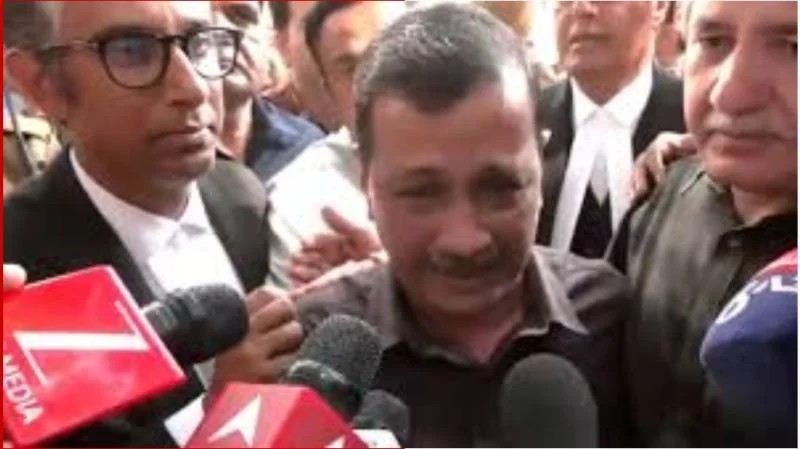
AAP leader Arvind Kejriwal breaks down after his acquittal in the liquor policy case on Friday. From the outset, he maintained that the case was less about policy and more about politics (Image: Screengrab from a news channel)
The acquittal of Arvind Kejriwal in the 2021–22 excise policy case marks a pivotal moment in contemporary Indian politics, closing a chapter that had cast a long shadow over the Aam Aadmi Party (AAP) and its leadership. The case, which centred on alleged irregularities in the formulation and implementation of Delhi’s now-scrapped excise policy, had led to a prolonged political and legal battle that Kejriwal consistently described as a “politically motivated conspiracy.”
The 2021–22 excise policy was introduced by the Delhi government with the stated aim of reforming the capital’s liquor trade. The policy sought to privatise retail liquor sales, increase government revenue and curb black-market practices. However, allegations soon surfaced that the policy had been designed to benefit certain private players. The Central Bureau of Investigation and the Enforcement Directorate initiated probes, alleging procedural irregularities, undue favours and financial impropriety.
“This is a conspiracy”
Kejriwal and his party firmly denied all allegations. From the outset, he maintained that the case was less about policy and more about politics. “This is not a corruption case; this is a conspiracy,” he repeatedly asserted in public addresses. According to Kejriwal, the investigation was orchestrated to destabilise his government and tarnish AAP’s anti-corruption credentials.
Throughout the proceedings, Kejriwal alleged that the charges were part of a broader strategy by the Bharatiya Janata Party (BJP) leadership to undermine political opponents. He directly named Prime Minister Narendra Modi and Home Minister Amit Shah, claiming they were “using central agencies to crush opposition voices.” At rallies and press conferences, he said, “When they cannot defeat us in elections, they try to jail us,” adding that “the real objective is to break AAP and stop our governance model from spreading.”
The legal battle intensified as several AAP leaders were summoned or arrested in connection with the case. Kejriwal described these actions as attempts to create a perception of guilt by association. “They want headlines, not truth,” he remarked during one hearing. Supporters of AAP echoed these sentiments, arguing that the timing of key investigative steps often coincided with important electoral cycles.
The court’s acquittal of Kejriwal hinged on the prosecution’s inability to establish direct evidence linking him to alleged wrongdoing. In its judgment, the court observed that suspicion, however strong, could not substitute for proof. The ruling effectively dismantled the central claims against him, reinforcing the principle that criminal liability requires clear and demonstrable evidence.
Following the acquittal, Kejriwal framed the verdict as vindication. “Truth has won,” he declared. “For two years, they tried to defame me and my party. Today the court has shown that these allegations were baseless.” He reiterated his charge that the case had been politically engineered, saying, “This was a conspiracy hatched at the highest levels to silence an honest government.”
The BJP, for its part, has consistently denied any political interference in investigative processes, asserting that central agencies function independently and that the case was based on credible inputs. Party leaders have argued that the acquittal reflects judicial scrutiny, not political absolution, and have maintained that accountability must remain paramount in public life.
The episode has broader implications for India’s federal and political landscape. The use of investigative agencies in cases involving opposition leaders has been a recurring point of contention in recent years. Critics argue that such actions can create a chilling effect, discouraging robust political competition. Supporters of the government contend that anti-corruption enforcement must be applied uniformly, regardless of political affiliation.
Impact on AAP and democratic discourse
For AAP, the acquittal provides both relief and momentum. The party has built its identity on governance reforms and an anti-corruption plank. Prolonged legal uncertainty threatened to erode that image. By emerging from the case without conviction, Kejriwal seeks to reposition himself as a leader who withstood political pressure. “We will continue to work for the people of Delhi with even greater determination,” he said after the verdict.
At the same time, the controversy underscores the fragility of trust between political institutions. When allegations of conspiracy are exchanged at the highest levels, public faith in impartial governance can suffer. Whether one views the excise policy case as a necessary investigation or a politically charged episode, its impact on public discourse is undeniable.
The acquittal closes one legal chapter, but the political narrative it generated is likely to persist. Kejriwal’s assertion that he was targeted by powerful adversaries will remain central to his rhetoric, while his critics may continue to question the policy decisions that led to scrutiny in the first place. In a deeply polarised environment, the case illustrates how legal proceedings can become arenas for broader ideological battles.
Ultimately, the court’s decision reaffirms a foundational legal principle: allegations must be proven beyond reasonable doubt. For Kejriwal, it represents personal and political vindication. For India’s democracy, it serves as a reminder of the delicate balance between accountability, due process and political contestation.