A 700 Km-Long Foot March To Save Sacred Groves From Solar Projects
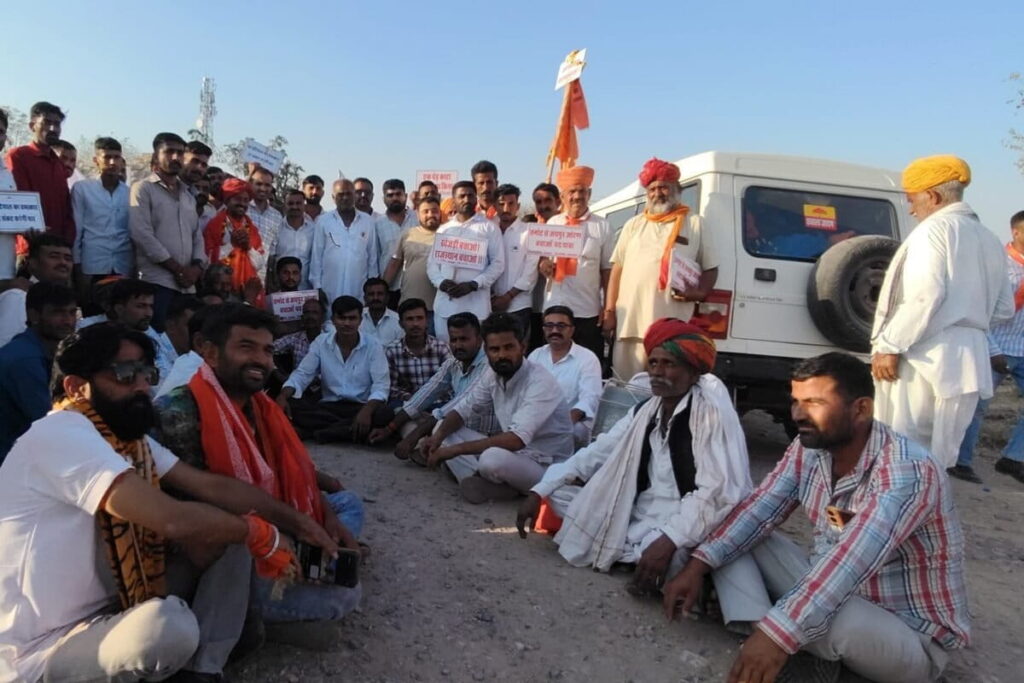
On January 21, around 100 villagers began marching in protest from Tanot Mata temple near the India-Pakistan border in Jaisalmer towards capital city Jaipur. They intend to pressure the state government for protection of orans, pastures, and catchment areas of water sources (Image by Parth Jagani)
- Village residents in Rajasthan are currently walking from the India-Pakistan border in Jaisalmer to the state capital, Jaipur, seeking protection for their sacred groves, pastures, and the catchment areas of water sources.
- Activists claim that 580,000 hectares of orans are wrongly classified as wastelands in revenue records.
- Large-scale solar energy parks have been sparking land conflicts in west Rajasthan, which have galvanised into a state-level protest now.
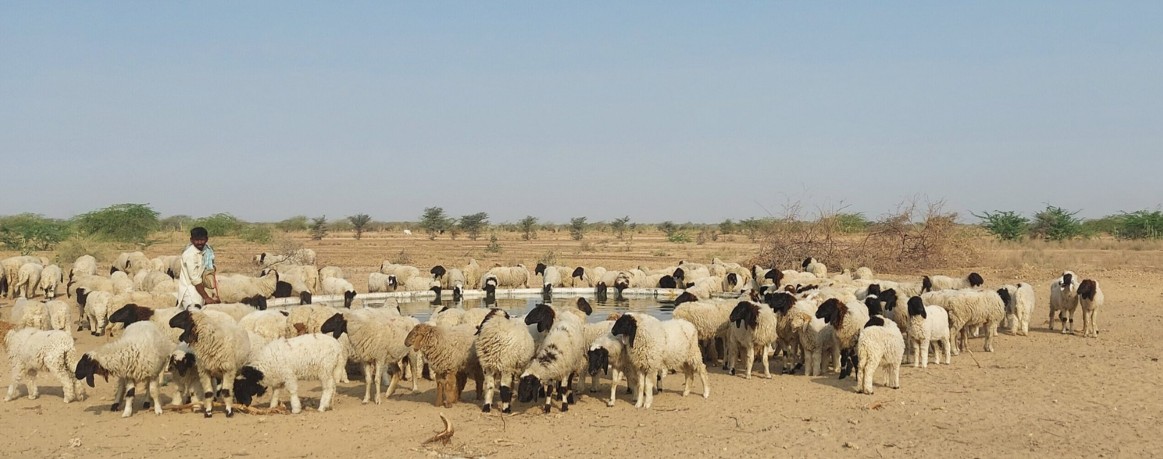
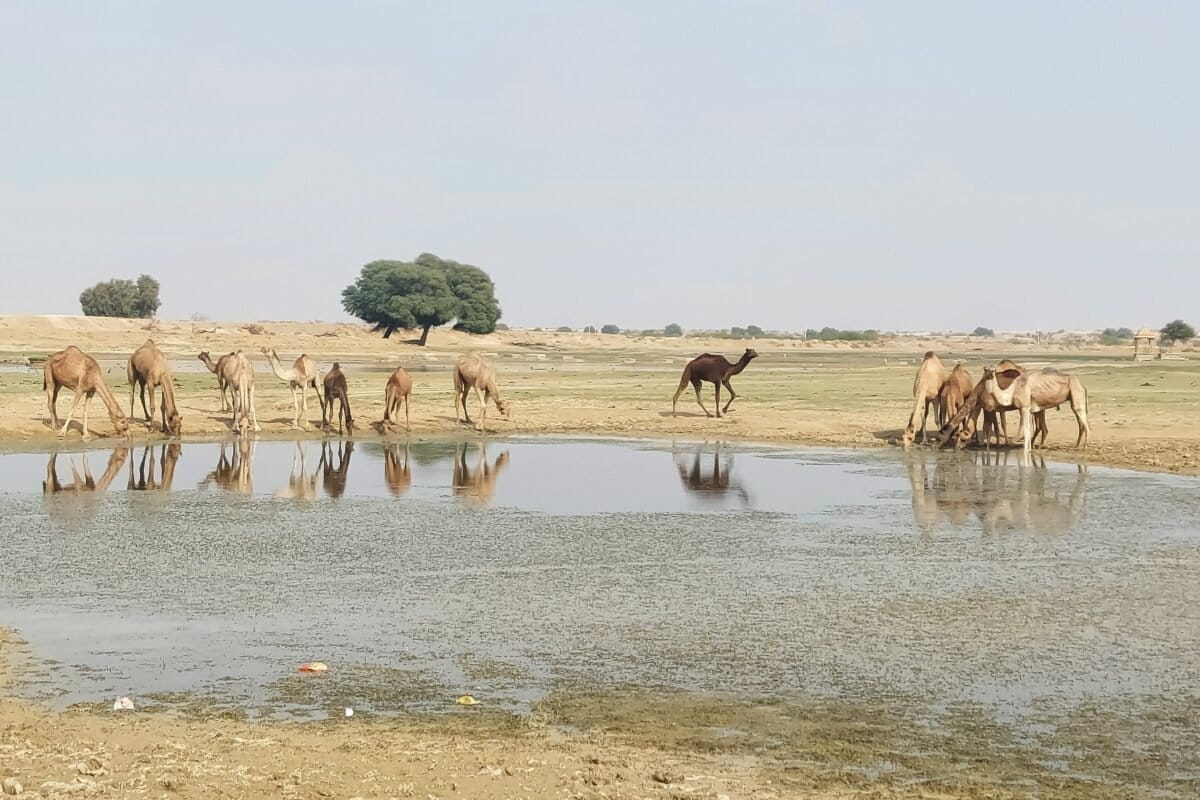
It was February 27. A herd of around 20 cows drank from the Biprasar pond, while a flock of sheep grazed nearby. Around 13 camels straddled in.
“Every day, thousands of animals, birds, and humans come to quench their thirst here. And this water is two years old because there was not much rain last year. Even when the seasonal rainfall is low, the vast aagor (catchment) helps us collect it here,” said Lal Singh, spreading his arm to indicate the extent of the land before growing sombre. “There is a proposal to set up a 400 MW solar energy park in the catchment. Where will all these animals go? How will we survive without water?”
Growing up in Ramgarh village of Jaisalmer district, Singh has imbibed the language of the desert ecosystem where people thrive on an average annual rainfall of around 100 mm spread over just eight days. This region has some of the lowest intensity of rainfall. For comparison, the average annual rainfall in India is around 1200 mm.
People here use traditional wisdom to harvest this little water from ponds, shallow and deep wells, and khadeens, and to rear animals on desert grasses and shrubs in orans (sacred groves) and gochars (pastures).
But a growing number of large solar power and mining projects in the region are now taking over these traditional community lands, threatening the traditional way of life and sparking conflicts that have grown into a broader movement in the last five years.
Walking for the sacred
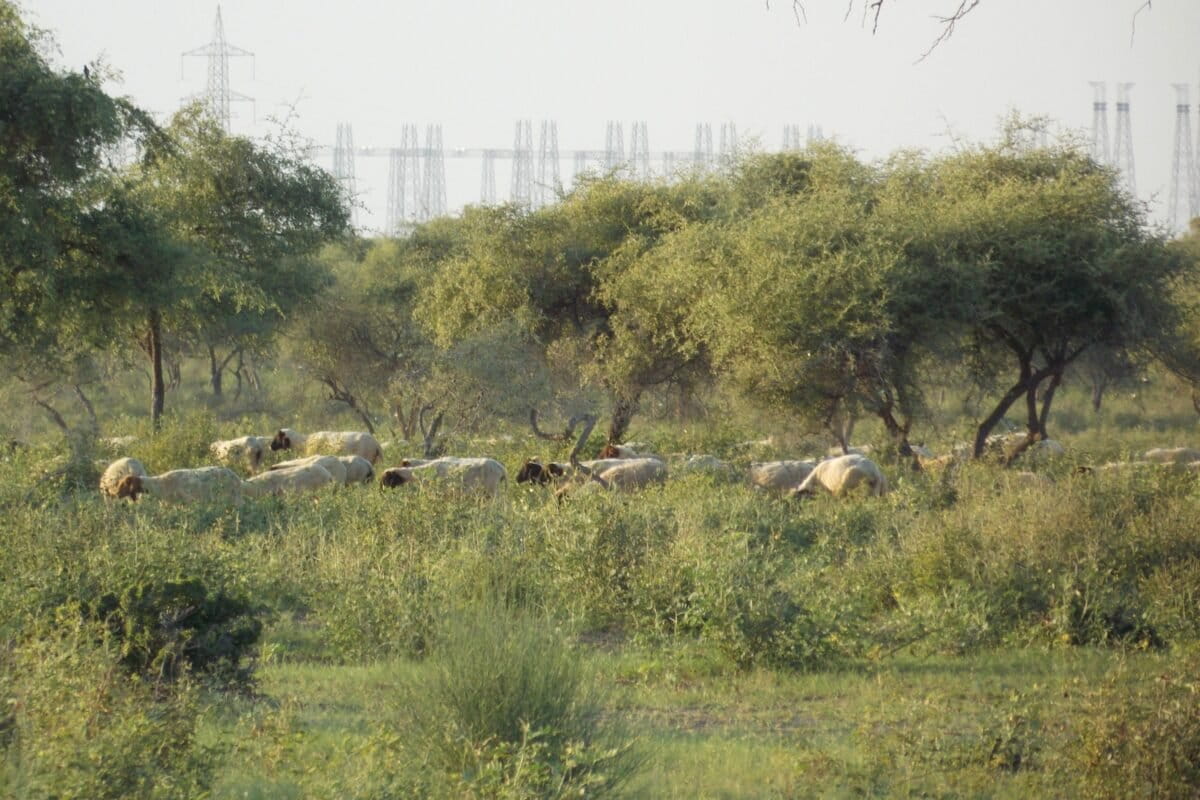
Orans are sacred groves dedicated to local deities or martyrs, conserved by local communities under strict rules governing extraction. While livestock are allowed to graze, tree cutting is not allowed, turning these into oases in the desert, harbouring a large number of indigenous trees like khejri (Prosopis cineraria) and rohida (Tecomella undulata), as well as the critically endangered great Indian bustard, caracal, and desert fox.
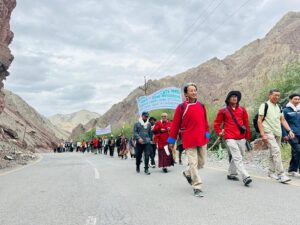
On January 21, around 100 villagers started a protest march from Tanot Mata temple near the India-Pakistan border in Jaisalmer, planning to reach the state capital Jaipur, a distance of around 700 km, by the end of March to press upon the state government for protection of orans, pastures, and catchment areas of water sources. Along the way, several thousand others are joining them in cities like Jaisalmer and Jodhpur, while villages en route offer a warm welcome with shelter and food. Several political leaders, cutting across party lines, have supported the campaign and raised the issue in the state assembly as well.
“The march is raising public awareness on the issue. We are expecting thousands of supporters from all over Rajasthan to enter Jaipur,” said Sumer Singh Bhati, a conservationist and activist who is leading the protest under the banner of ‘Save Oran.’ “We are not against development, but the focus on large-scale solar energy projects, requiring thousands of hectares, is taking away our sources of survival and livelihood.”
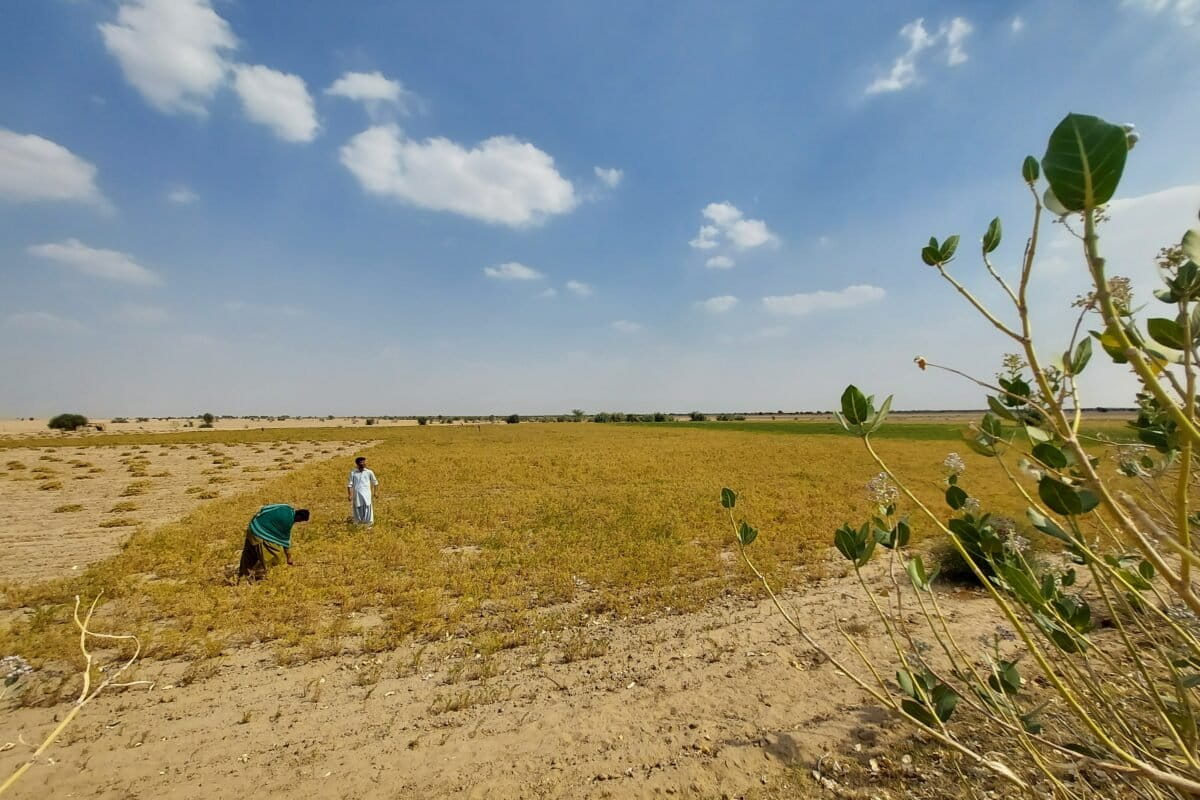
At Bandha village, for instance, the state government allotted 2,397 hectares for a 1 GW solar power project, forcing livestock owners to look for alternatives to the grassland that is now enclosed.
“Earlier, the animals could graze freely, but now there is limited land. This has forced people to reduce their herd size,” said Swaroop Ram, a resident of Bandha village. “In records, our pasture was classified as wasteland, thus making it easier for the government to allot it to the companies.”
The Rajasthan Tenancy Act 1955 and the Rajasthan Land Revenue Act 1956 restrict the use of pastures and catchment of water resources for industrial and infrastructural purposes, and subsequent judgments have reinforced the rule.
But wastelands can be easily allocated, which is why the locals are pressing for accurate classification of their community lands.
“Our estimate suggests that around 5.8 lakh (580,000) hectares of orans in Jaisalmer district are classified as wasteland in government records,” said Bhati.
“We did not know about this wrong classification and had no reason to worry because there were negligible industrial projects in the desert, and they usually required just a few acres. Solar parks, however, are different. They are being set up in thousands of hectares, and so many of them are coming up now.”
Mongabay-India reached out via email to the Rajasthan Rajya Vidyut Utpadan Nigam Limited (RRVUNL), the Rajasthan Renewable Energy Corporation Limited, and the Jaisalmer district collector to inquire about the safeguards employed when allocating land for solar energy parks. No response was received at the time of publishing.
The solar surge
With over 325 sunny days a year, Rajasthan has emerged as India’s renewable energy hub. The state ranks first in solar power, boasting an installed capacity of 22,860.73 MW. The Rajasthan Clean Energy Integrated Policy aims to achieve a target of 125 GW Renewable Power Projects by 2029-30, including 90 GW solar. Some 44,247 hectares of land were allotted for solar parks with a capacity of 23 GW between 2023 and 2025.
The conflicts arising out of such expansion have also reached court. Residents of Nedan village, for instance, filed a case in 2018 arguing that a 600-MW hybrid solar-wind project by the Adani group had restricted access to orans, leading the Rajasthan High Court to cancel the allotment of land to the group. In another case, the Adani group had to return 205.3 hectares of oran land it had acquired for a solar power project at Baiya village, following vehement opposition from the locals last year.
“Solar parks don’t generate jobs for the locals, except a few who are hired as security guards or cleaners of solar panels. If the government is really serious about the welfare of people, they should promote small, decentralised solar plants owned by communities,” said Bhopal Singh, a leader of the Save Oran group. “Large solar parks and mining projects only benefit a few businessmen while villagers are forced to either migrate to cities or resort to poorly paid labour work. In contrast, livestock rearing has helped people survive in this harsh region for generations.”
According to the 20th Livestock Census 2019, Jaisalmer district had around 24 lakh cows, goats, sheep, and camels, but activists say the recorded pasture area is not enough for their survival. A tehsildar can earmark pasture land in consultation with the village panchayat by roughly allocating 0.12 hectare for each cattle head, says the Rajasthan Tenancy (Government) Rules 1955.
“Our assessment of 45 villages based on livestock census shows that the pasture land in records is invariably short of the requisite area. We have written to the Jaisalmer district collector to do similar assessments for all villages of the district and allocate the pasture area accordingly,” said activist Balwant Singh Jodha. “A cow consumes 5 kg of dry fodder daily. If we buy from the market, it will cost ₹2,800 every week. This is why it’s essential to have orans and gochar for every village.”
Orans as forests
In 2005, the Supreme Court’s Central Empowered Committee recommended detailed mapping of orans and their classification as forests. The recommendations, however, remained unimplemented, and after several follow-up interlocutory applications, the court directed the Rajasthan government in December 2024 to enforce the recommendations and to form an expert committee to identify various forms of desert ecosystems, such as grassland, rocky outcrops, and stony desert, and to consider them as forest land.
In December 2025, the state government-formed committee proposed 11,313 bigha (2,977 hectares) of land in three villages of Jaisalmer district for classification as oran. Many other villages, however, are yet to be surveyed.
“No orders have yet been issued to the local revenue officers to carry out this exercise, and hence most villages are not able to take up new proposals in their panchayats,” said Parth Jagani, a Jaisalmer-based environmentalist and farmer. “Until this mapping is done, no land should be allotted or leased out for any commercial activity.”
Mongabay-India reached out to the Principal Chief Conservator of Forests and the Jaisalmer district collector to inquire about ground mapping of the orans and pasture lands. Their responses are awaited.