The Year 2022 Saw The Driest Spring In 4 Centuries In The Western Himalayas
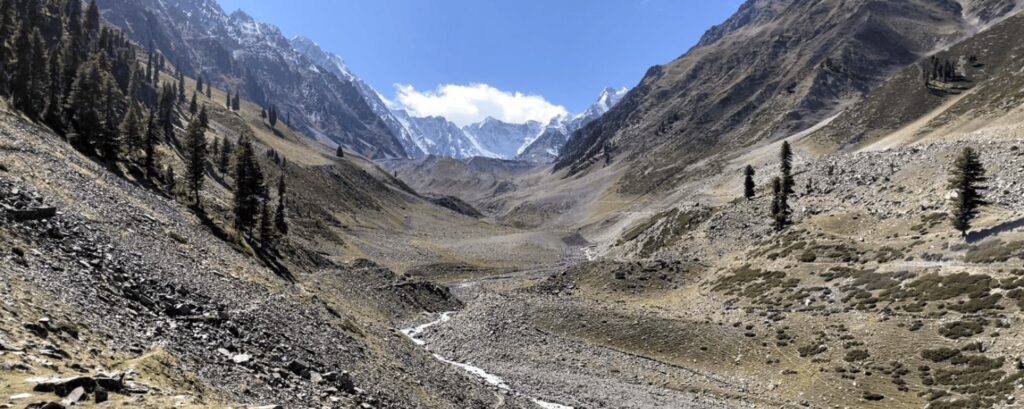
Trilokinath glacier valley in Lahaul. To build the climate record of Lahaul through tree rings, the researchers chose three field sites — Udaipur, Salpat and Trilokinath, from where they collected 88 cores from over 50 trees (Image courtesy of Pushpendra Pandey)
- Researchers extracted tree cores from old deodar trees in Lahaul, Himachal Pradesh, to reconstruct 396 years of rainfall history of the spring season.
- They found that the spring of 2022 was the driest on record and the last two decades are the driest period in the entire 396-year reconstruction.
- The findings have implications for water security, disaster management, and agriculture across northern India, which depends on snowmelt from the Himalayas.
Climate science researcher Pushphendra Pandey recounts how a day in the field looked like in Lahaul in Himachal Pradesh between September and October 2023. The team of nine including other students, professors, a driver and a local guide, would rise at six each morning at their homestay, eat breakfast, and trek for at least an hour to reach the old-growth cedar forests of Lahaul, spending the full day, perched on steep slopes and extracting tree cores.
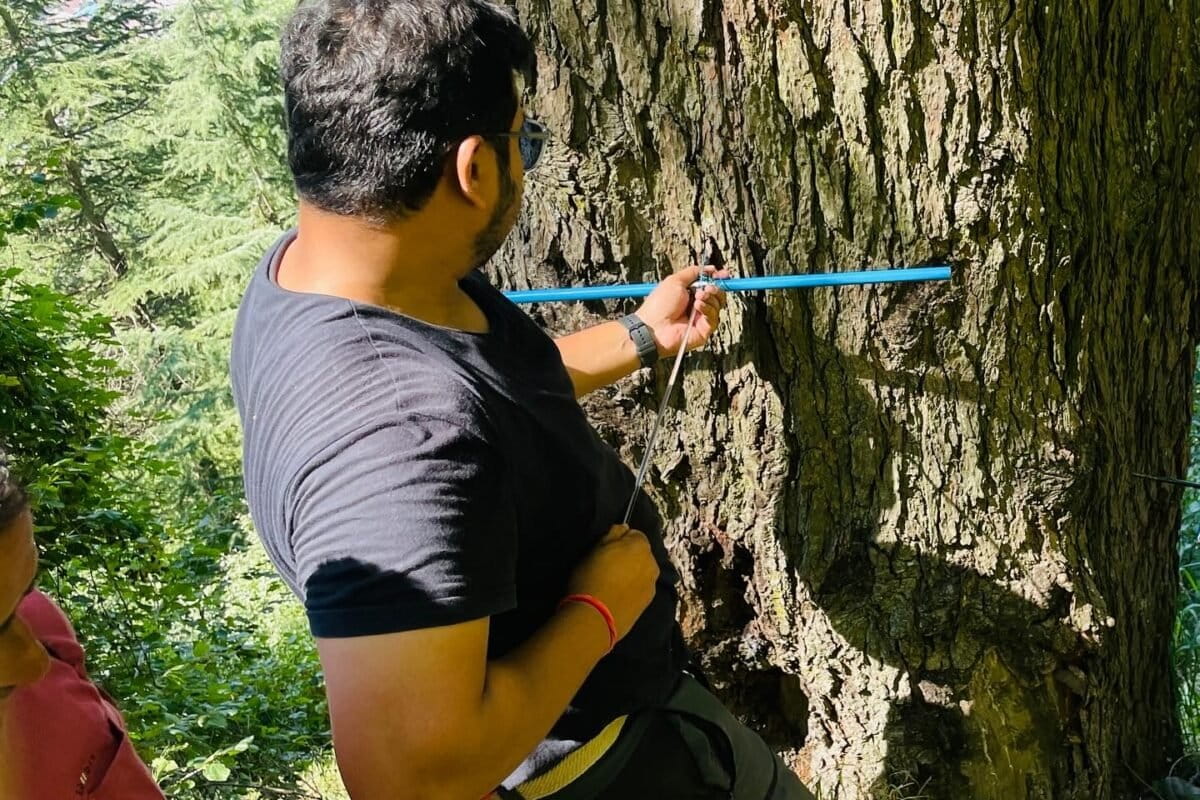
Each night, the team sat stapling plastic straws together to create packaging for the cores they planned to collect the next day. “The cores are delicate but hard to get. All trees do not get cored easily,” said Pandey, who is a research scholar at Birbal Sahni Institute of Palaeosciences (BSIP) in Lucknow.
Lahaul is a dry region in the Himalayas with forests, making it an ideal location to study water-sensitive trees. The team chose old deodar trees, also known as Himalayan cedar (Cedrus deodara) in undisturbed areas away from villages, in stable terrain free from landslides and avalanches. They were trying to find rainfall history from tree rings, the bands inside a trunk that represent a year’s growth. These widen when rainfall is plenty and narrow when water is scarce. Temperature matters too. But in Lahaul, water availability is the dominant signal the trees respond to.
The year 2022 was the driest spring season in the Western Himalayas in nearly four centuries, making it the driest on record across a 396-year climate reconstruction, the team found. The findings have been published in a recent study authored by Pandey, Mayank Shekhar and Parminder Singh Ranhotra from BSIP and other scientists at Indian Institute of Tropical Meteorology, Oak Ridge National Laboratory, and Central University of Punjab.
From the forest to the laboratory
Scientists typically study tree rings by using a borer, a hand-operated drilling instrument, to extract cylindrical core samples from the trunks of trees and estimate their age from the rings, instead of cutting down a tree. “First, we had to take permission from the Forest Department because the trees should not be damaged or hurt,” said Pandey. The borer is held at chest level against the bark of the tree and rotated anticlockwise a couple of times until the core gets separated, he explained, while noting that there are a few other ways to determine how old a tree is but more or less the wider their girth, the older they are.
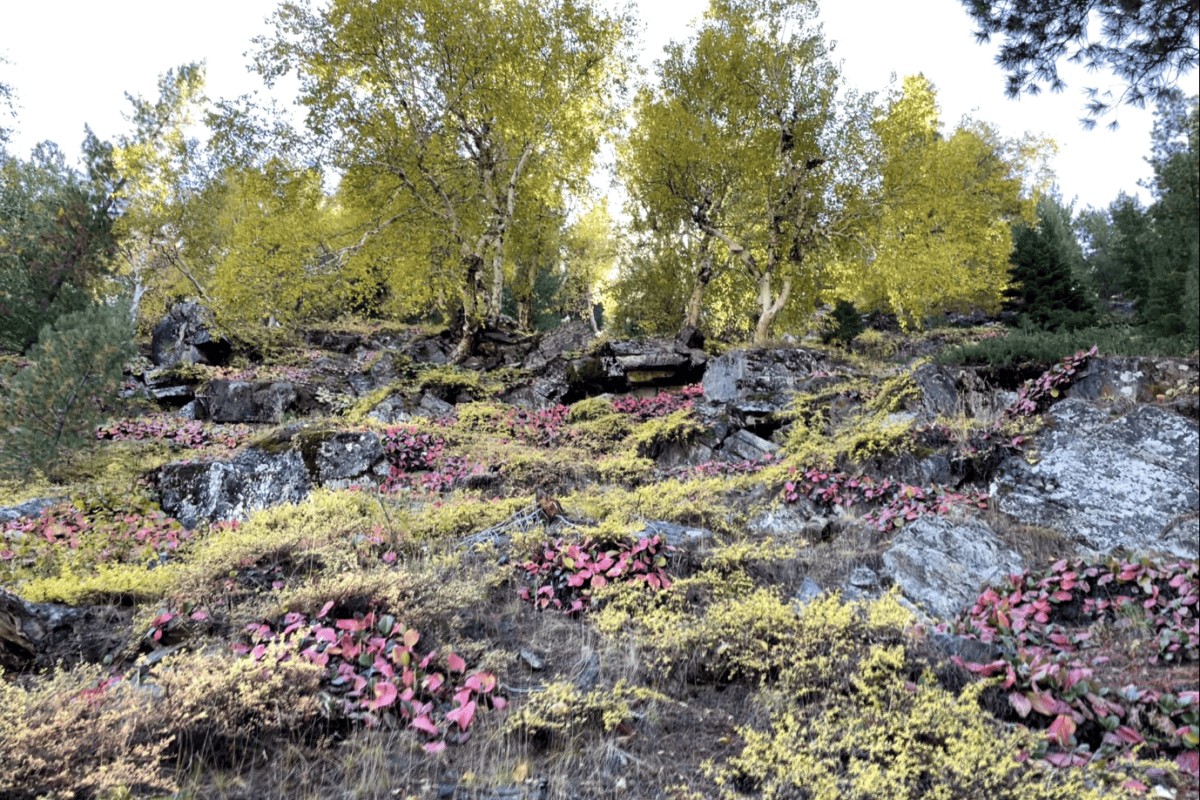
To build the climate record of Lahaul through tree rings, the researchers chose three places — Udaipur, Salpat and Trilokinath. They collected 88 cores from over 50 trees. “Most of the time we were working on a steep incline. It’s very risky,” said Pandey. After extraction, the team immediately packed the fragile cores and labelled them.
Back in the laboratory, the team polished the cores with sandpaper until the alternating light and dark bands showing yearly growth became clearly visible.
Next, they measured the ring widths under a microscope on a digital positioning table, which rotates each core and records the width of each ring in millimetres.
The last step was establishing what the tree rings were responding to. Using climate data from the India Meteorological Department (IMD) going back to 1934, the team made a statistical correlation showing that precipitation from February to May was what drove tree growth at these sites rather than the temperature.
They then used another model to extrapolate this relationship backwards through the entire 396-year tree-ring record.
The driest spring in four centuries
“We knew that droughts are increasing and snowfall is reducing but the most surprising thing was how 2022 was the driest spring in almost 400 years,” Pandey told Mongabay-India.
It was not the tree rings alone that helped the researchers draw that conclusion. They also examined precipitation records from the meteorological station in Keylong, district headquarters of Lahaul, and multiple datasets, all of which confirmed this finding. A third independent line of evidence came from satellites.

Scientists tracked Outgoing Longwave Radiation (OLR) over Lahaul, heat that escapes upward from the Earth and its atmosphere into space. More of it escapes when skies are clear; less escapes when clouds are present. Over the past four decades, this measure has been steadily rising over Lahaul each spring, according to the study. In 2022, it reached its highest recorded value – the clearest, driest spring skies in the entire measurement period, confirmed from space.
The last two decades from 1999 to 2022 have been the driest in four centuries, according to the study. There has been a shift in the frequency of extreme weather events over the last 75 years, noted Pandey. In the early 20th century, there were longer, more stable wet and dry phases, which changed in the later part of the century when extreme fluctuations became more frequent, one year seeing drought, the next seeing floods, he explained.
What caused the 2022 drought? The researchers think it was linked to the unusual warming of sea surfaces in the Indian and Pacific Oceans. This warming caused the subtropical westerly jet to shift northwards, reducing the moisture that was transported to the Western Himalayas, resulting in fewer Western Disturbances.
The winds that bring rain to Lahaul and Spiti
Rain and snow are the source of life in the Hindu Kush Himalaya region, providing freshwater to billions across South Asia. The amount of rain, snow, and hail (called precipitation) in the winter and spring in this area affects how much snow accumulates in the mountains. This, in turn, influences the amount of water that flows downstream. Two of India’s major rivers, Ganga and Indus, depend on this precipitation, providing water security across northern India.
Most of that precipitation arrives through a chain of weather systems that many Indians would not recognise. The majority of India depends on the southwest monsoon, a seasonal shift in winds every summer that carries rain from the ocean across the subcontinent, for rainfall each year.
But Lahaul and Spiti receive more than half of their rain and snow from a different source of precipitation entirely, during winter and spring. Think of this source as Russian dolls, each nested within the other. The outermost doll is the westerlies – prevailing winds that blow from west to east in the mid-latitudes of both the Northern and Southern hemispheres. Within them is a faster, more concentrated band of winds called the subtropical westerly jet. And travelling within that jet are the Western Disturbances, cyclonic storms that draw moisture from as far as the Mediterranean region and deposit it as rain and snow when they reach the Himalayas. Researchers think when the jet weakens or shifts northward, fewer Western Disturbances reach the Himalayan region and the mountains go dry.
Keshav Upadhyay, who teaches forestry at Mizoram University and specialises in dendroecology, a discipline that studies tree ring patterns to assess the history of tree growth and the impacts of environmental disturbances validated the researchers’ approach. He also highlighted that the Lahaul region is primarily influenced by westerlies rather than the southwest monsoon, which makes spring precipitation the main driver of tree growth there. “I think this is the first of its kind research from Lahaul and Spiti,” he said.
He added that the study’s conclusion that dry conditions have been increasing in the region since 1999 is consistent with other studies on higher Himalayan areas affected by the westerlies. Since reliable weather records in India exist only from around 1900 onwards, such dendrochronological reconstructions are crucial for global climate models, Upadhyay told Mongabay-India, adding that understanding of the results could be improved by conducting similar studies at additional sites within the study area, because in hills with elevation differences, terrain and soil factors can vary between sites and more sites would help confirm that results have not been skewed by highly local conditions.
Pandey observed that the meteorological data used in the study is also limited, considering the number of weather stations in the Himalayas is quite low, which makes the data sparse. The additional datasets used in the study rely on satellite data, which may not be fully accurate because satellites cannot fully observe precipitation in rugged high-altitude terrain, he explained. Another gap is that the number of Western Disturbances reaching the region per year is not well known, which tends to vary from year to year, he said. The study notes that climate change could be making the region drier, it also cautions that this needs to be studied further.
The study’s insights can be applied to understanding water security, hazard risk, agriculture and urban planning in the hills. Prolonged spring droughts could reduce water availability for agriculture, drinking water and hydropower across northern India. “If we know that a particular region has higher chances of facing a hazard, then people should not settle there and stay away from there,” said Pandey. Long term climate data derived from tree rings can be linked to past events and used to make predictions for the future, enabling better planning for agriculture, forestry management, and urban planning, said Upadhyay.
Tree rings have now told us that 2022 was the driest spring in four centuries. What else can they tell us? Upadhyay suggests that exploring dendropyrochronology — a new discipline that uses fire scars in tree rings to reconstruct the history of forest fires — could help investigate the increasing frequency of forest fires in the Himalayas and inform fire management plans.