Disease-Laden Microplastics In The Air We Breathe
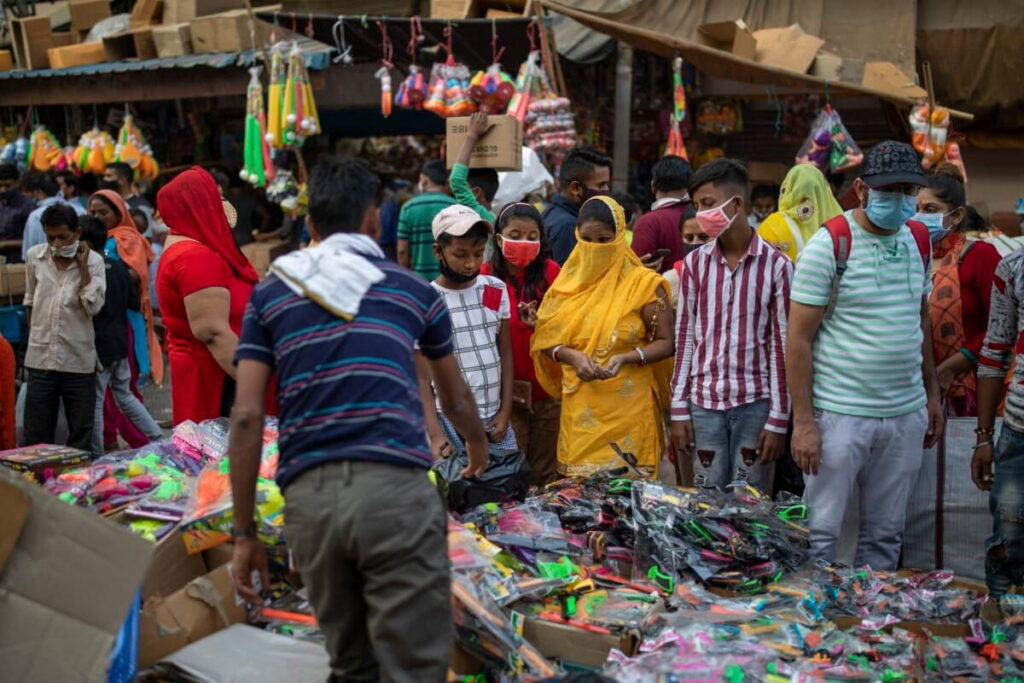
A market in New Delhi. As part of the study on inhalable microplastics, the researchers investigated air samples from November 2022 to March 2023 from five most densely populated markets in the megacities of Delhi, Mumbai, Kolkata, and Chennai, emblematic of India’s primary urban clusters (AP Photo/Altaf Qadri)
- A new study from Indian megacities identifies inhalable microplastics as an emerging air pollutant.
- These micron-sized particles not only bypass barriers in the nose to reach the lungs but also carry pathogens that could find a host in the human body and multiply.
- Even as India opposes caps on plastic production, scientists say emerging evidence confirms concerns around microplastics and highlights the need for global action to curb plastic pollution.
An average resident of an Indian city can inhale nearly three grams of plastics over their lifetime, almost the weight of a small plastic bottle, according to a new study that looked at an emerging airborne pollutant – inhalable microplastics (iMPs) – and their implications for human health.
Inhalable microplastics are a subset of airborne microplastics. While airborne microplastics are typically less than 5 mm in size, inhalable microplastics are 500 times smaller, at less than 10 microns in size, a size that can penetrate the nasal cavity and enter the lungs, says the study in the journal Environment International.
Typically, fine particles from dust, smoke, and fuel, are categorised either as PM2.5 or PM10, which are particles considered responsible for air pollution. But microplastics now make up as much as 5% of these particulate pollutants in India’s cities, says the study conducted by the Indian Institute of Science Education and Research (IISER), Kolkata in collaboration with the All India Institute of Medical Sciences, Kalyani, the Institute of Mathematical Sciences, Chennai and Homi Bhabha National Institute, Mumbai.
“This research points to the anthropogenic plastic dust, caused by weathering of clothes and tyres – products that are a part of urban life. Microplastics are not yet included in air quality standards like PM2.5 and PM10, but their persistence and toxicity mean they should be. We urge policymakers to officially recognise inhalable microplastics as a new air pollutant,” said Abhishek Biswas, researcher at the Environmental Nanoscience Laboratory at IISER, Kolkata, who played a lead role in the study.
“It is an important finding that microplastics are a significant part of air pollution. It is great seeing more studies on microplastics in the atmosphere, in particular from large cities with a lot of air pollution and in a context of low/middle income countries for which we often lack such data,” said Martin Wagner, an ecotoxicologist at the Norwegian University of Science and Technology and a member of the Scientific Coalition for an effective plastic treaty, a body advocating for science-based decision making at the United Nation’s global plastic treaty negotiations.
Investigating the air in city markets
While earlier studies have shown that microplastics (plastic particles less than 5 mm in size) are ingested through food, water and dermal contact, the fourth pathway, breathing, has not been explored much. “Most of the studies conducted on airborne microplastics had samples taken at a height of 10-15 feet. This is the first study to directly measure these plastic particles at human breathing height in the busy markets of Delhi, Kolkata, Mumbai, and Chennai,” said Biswas.

The study was conducted in five most densely populated markets in each of these megacities, with air samples collected between November 2022 to March 2023. Two sample categories, active and passive, were collected. Active samples were taken with an instrument called Cascade Impactor that has different pore sizes and can thus mimic inhalation in human beings, stopping larger particles in the beginning while allowing finer ones to go inside. Passive sampling involved collecting airborne microplastics (AMPs) falling in a petri dish on various surfaces in the market. Pyrolysis Gas Chormatography-Mass Spectrometry, an analytical technology only available with two institutes in India, was used to identify and quantify these particles.
The highest concentrations of iMPs were found in Kolkata (14.23 microgram/m³) and Delhi (14.18 microgram/m³), followed by Chennai (4 microgram/m³) and Mumbai (2.65 microgram/m³).
Eleven types of plastic polymers were identified in the samples, with the major ones being polyethylene terephthalate (PET), polyethylene, synthetic butadine rubber and Nylon 66. “Most of these plastics come from synthetic clothing (polyester), packaging, vehicle tyres and footwear,” said Biswas.
The concentration of airborne microplastics, which iMPs are part of, increased by 14-71% during winter as compared to summer. “This rise is linked to winter clothing, synthetic materials, poor waste management, denser air near the Earth’s surface during winter due to temperature inversion (a layer of warm air in the atmosphere trapping pollutants), increased vehicle use and unventilated spaces,” the study says. Within a complete day, the highest iMP levels were observed in the evening, when markets are crowded.
In coastal cities such as Chennai and Mumbai, lower levels of airborne microplastics are likely due to stronger wind currents and smaller crowds compared to Delhi and Kolkata. “However, unlike dust, microplastics don’t easily settle or wash away. Their light and aerodynamic shapes keep them floating for long periods- they can travel through the air to rivers and oceans, eventually returning to us through seafood and salt,” said Biswas.
Couriers of disease
In addition to being a pollutant themselves, iMPs also carry pathogens that could lead to diseases.
Samples collected from densely populated areas identified 28 “respirable emerging contaminants” that are transported by AMPs. Respirable emerging contaminants are chemicals not currently regulated but having ecological or human health concerns. Crosschecking them against previous studies, the researchers found that five of them are classified as carcinogens, nine as endocrine disruptors, seven as neuro-toxicants and 15 as skin, eye and respiratory irritants.
“This cocktail of associated contaminants, including phthalates (chemical additives in plastic) and heavy metals such as lead are linked to cancer, endocrine, cardiovascular, respiratory, neurological and reproductive diseases. This adds extra toxic burden on top of the already extreme PM2.5 levels that are known to shorten life expectancy by many years in these cities,” said Dr. Mahesh Ravikumar Jansari, from the Department of Pulmonary Medicine, AIIMS Kalyani, in West Bengal.
“Once inside the lungs, some of the ultra-fine particles (less than 1 micron) can enter the blood stream and reach anywhere, even heart and brain. While particles (between 10-2.5 micron) can cause irritation, the finer particles (between 2.5-1 micron) can reach inside lungs till alveoli and cause inflammation,” he said.
AMP were also found to harbour diverse microbial communities, including pathogens and antibiotic-resistant genes. “The drains passing through the markets do not just contain water from washing synthetic clothes which contains microplastics but also microbes released from faecal matter which is likely to contain the antibiotics that we consume. This microbial growth latches on these microplastics because of their rough surface. Any disturbance in the atmosphere causes them to rise into the air and enter the human lungs while breathing and also be exhaled back in the same environment,” said Biswas.
“Imagine a COVID-like situation where such pathogens can re-enter the environment via coughing or sputum, creating a feedback loop of human-to-air-to-human transmission in an already overburdened health system,” said Dr. Jansari.
Dr. Jansari advises wearing natural fibres, avoiding unnecessary synthetic fast fashion and not burning household or market plastic waste to ward off local generation of AMPs. “At community and policy level, we also need better market design and ventilation, and tighter control of traffic and tyre wear around dense commercial hubs besides stronger plastic waste management,” he said.
Microbes on microplastics resistant to medicines
Antibiotic resistant genes were also identified on the samples. “Microbes carried by iMPs possess enhanced pathogenicity and resistance against broad-spectrum drugs like tetracycline and are more likely to be multidrug-resistant,” the study says. Antimicrobials are medicines used to prevent and treat infectious diseases in humans, animals and plants. When bacteria, viruses, fungi and parasites no longer respond to antimicrobial medicines, it is termed as anti-microbial resistance (AMR). With increasing AMR, it is becoming become difficult to treat infections and increase in the risk of disease spread. The World Health Organisation terms AMR as one of the top global public health and development threats.
Studies show that since microplastics are inert and have a tough surface, when they interact with microbial communities in the environment, the bacteria can form a biofilm on it. The low density of microplastics in turn, is ideal for long-distance transportation and dispersal of pathogens and can also provide an ideal habitat for the bacteria to develop antimicrobial resistance.
“AMR is already something to be worried about. And as this study indicates, when we are inhaling microplastics, it is even more concerning as it adds to another pathway to the spread of antibiotic-resistant pathogens,” said Rajeshwari Sinha, who leads the AMR programme at the Centre for Science and Environment, an environmental thinktank in Delhi.
At the recently held United Nations Environment Assembly in Nairobi in December 2025, a resolution was passed to deal with the environmental effects of AMR. However, delegates did not agree on including a reference on the role of microplastics as vectors of AMR. Scientists working on plastics said emerging data validates scientific concerns regarding the impact of microplastics, especially coming from developing countries. This also underscores the need to take international action to end plastic pollution as a matter of urgency, said Richard C. Thompson from the University of Plymouth, United Kingdom and a microplastic expert.
“There is good evidence that microplastics from a range of sources are in the air we breathe. There is evidence of accumulation across a range of human tissues including in the lungs. So, I am not surprised to hear they have been detected in the human nose. There is also evidence that microplastics transport pathogens in aquatic environments. Confirming the presence of pathogens coating airborne microplastics is a logical extension of this, but evidence confirming their presence if of key importance,” said Thompson, also the co-coordinator of the Scientific Coalition for an Effective Plastic Treaty.
The Indian position at the treaty negotiations has been against reducing primary plastic production. “I understand that countries like India and others need to walk the fine line of promoting their economic development and protecting the health of their people and environment. That may render them somewhat cautious about what a global plastics treaty should or should not do. However, there are also misconceptions that global rules on plastics would be negative for the economy. Such rules would actually promote a safer and more sustainable production and use of plastics, with massive benefits for health and the economy,” said Wagner.
(Published under Creative Commons from Mongabay India)