After Oppn Uproar, Centre Puts Draconian FCRA Bill On Hold
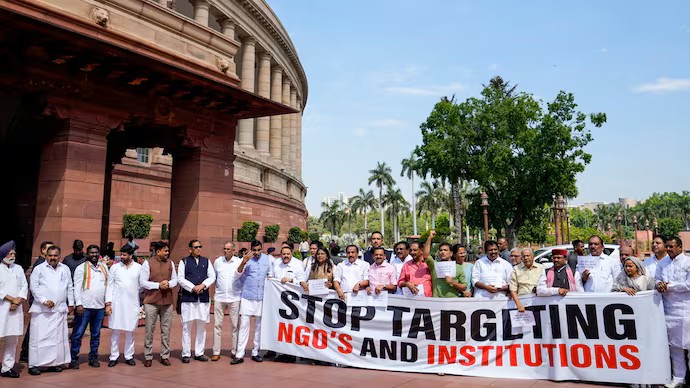
Opposition MPs stage a protest against the FCRA Bill in the Parliament Complex on Wednesday (PTI Image)
Amid intensifying Opposition pressure and fears of political fallout in poll-bound states, the central government on Wednesday was forced to pause the contentious Foreign Contribution (Regulation) Amendment Bill, 2026, in Parliament. The decision followed coordinated protests by Opposition MPs, led by the Congress, who accused the government of attempting to tighten its grip over civil society through sweeping new provisions.
Scenes of protest unfolded inside the Parliament complex, with MPs raising slogans and holding placards against what they described as an attempt to “bulldoze” legislation with far-reaching consequences. The Bill, tabled earlier by Minister of State for Home Affairs Nityanand Rai, has quickly become a flashpoint, drawing criticism from across the political spectrum.
At the heart of the controversy is a provision that allows the government to take control of assets created using foreign funds if an organisation’s licence is suspended or cancelled. Critics argue that such sweeping authority effectively places non-governmental organisations at the mercy of the state, raising serious concerns about autonomy and due process.
Opposition Flags ‘Draconian’ Provisions
Opposition leaders have been unequivocal in their criticism, calling the Bill “draconian” and a direct threat to democratic freedoms. Congress leader Manish Tewari said the proposed amendments “trample and transgress on the fundamental principles of law and natural justice.”
“There is quite a lot of concern with regard to the provisions,” Tewari said at a press conference. “We assure the people that when the Bill comes up for discussion, the Congress will take a stand against it and ensure it is referred to a Joint Parliamentary Committee or Standing Committee for a threadbare discussion.”
The demand for wider consultation reflects a broader unease about the speed and timing of the legislation. Opposition parties have alleged that the government attempted to push the Bill through Parliament at a time when many parties are preoccupied with election preparations, thereby limiting scrutiny and debate.
In a sharply worded statement, the Congress accused the government of orchestrating a “conspiracy” to pass the Bill without adequate discussion. “The Modi government is hatching a conspiracy to forcibly pass the FCRA Amendment Bill in Parliament,” the party said. “This decision is completely unconstitutional and against democracy. We will not allow this Bill to pass at any cost.”
The criticism is not limited to procedural concerns. Several Opposition leaders have warned that the amendments could disproportionately affect organisations working with vulnerable communities, including minorities. By expanding the state’s control over foreign funding, they argue, the Bill risks stifling dissent and curbing the activities of groups engaged in advocacy, research, and social work.
The controversy has also taken on a regional dimension. In Kerala, where elections are approaching, both the ruling Left Democratic Front and the Opposition United Democratic Front have demanded the Bill’s withdrawal. Chief Minister Pinarayi Vijayan has written to the Prime Minister urging reconsideration, signalling rare political convergence on the issue.
Government Defends Intent, Questions Persist
The government, however, has pushed back against the criticism, maintaining that the amendments are necessary to ensure transparency and accountability in the use of foreign funds. Parliamentary Affairs Minister Kiren Rijiju said the proposed changes are aimed at “tightening compliance and preventing misuse.”
According to the government’s position, stricter regulations are essential to safeguard national interests and ensure that foreign contributions are used for legitimate purposes. Officials argue that existing frameworks have loopholes that can be exploited, and that the amendments seek to close these gaps.
Yet, critics remain unconvinced. They argue that while transparency and accountability are legitimate goals, the means proposed in the Bill are disproportionate and risk undermining fundamental rights. The provision allowing the government to take over NGO assets has been particularly contentious, with opponents questioning its compatibility with principles of natural justice.
The timing of the Bill has further fueled suspicion. With several states heading into elections, Opposition parties see the move as politically motivated, designed to weaken civil society organisations that may be critical of the government. This perception has deepened mistrust and contributed to the intensity of the backlash.
The decision to put the Bill on hold suggests that the government has, at least temporarily, acknowledged the scale of the opposition. However, the pause is widely seen as tactical rather than substantive, with little indication that the proposed provisions will be significantly revised.
For many observers, the episode highlights a deeper and ongoing tension between regulatory oversight and the autonomy of civil society. While governments have a legitimate interest in monitoring foreign funding, the concentration of power in the hands of the state raises concerns about potential overreach.
As the standoff continues, the future of the Bill remains uncertain. What is clear, however, is that the debate has moved beyond technical provisions to fundamental questions about democracy, accountability, and the role of independent organisations in India’s public life.
For now, the Centre has stepped back under pressure. But unless the concerns raised by Opposition parties and civil society groups are meaningfully addressed, the confrontation is likely to resurface—perhaps with even greater intensity.