LPG Supply Shock Exposes Fragility Of India’s Clean Cooking Strategy
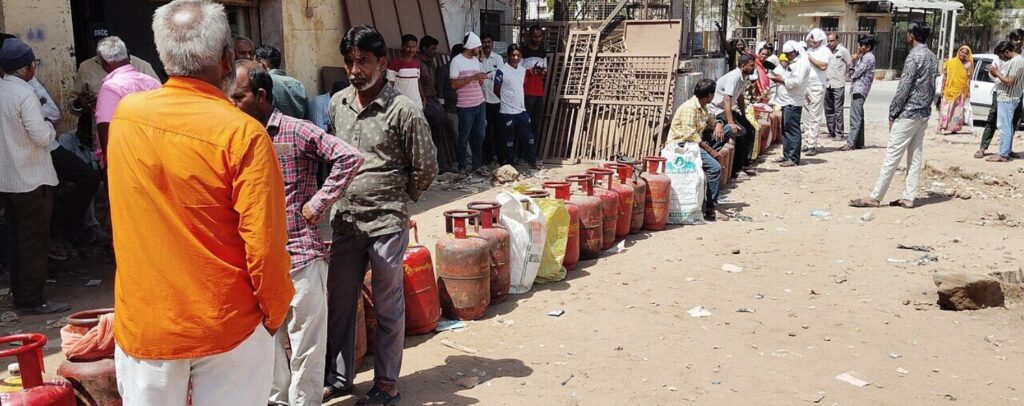
People queue up to refill cylinders during the LPG shortage in March 2026 (Image by Nizil Shah via Wikimedia Commons)
- India’s reliance on imported LPG has come under strain, as supply disruptions cause delays and uncertainty.
- The disruption has caused a temporary return to firewood, particularly among low income households, hostels, and eateries.
- Analysts say the disruption offers a critical moment to rethink India’s cooking energy mix and invest in more reliable, decentralised alternatives.
In the streets of Bhalaswa, a neighbourhood in north-west Delhi, Rama is known as “cylinder wali madam”. For years, she has facilitated LPG connections for low-income residents, persuading them to put away their wood and coal-fired stoves and helping them secure subsidies under the Pradhan Mantri Ujjwala Yojana (PMUY), a government scheme to promote the use of LPG. For the last two weeks, however, she’s had to watch her efforts come undone as delays hit LPG supplies, triggered by the Israel-Iran conflict thousands of kilometres away.
“The irony is, despite my nickname, I am struggling to secure an LPG cylinder myself,” Rama, a social worker, told Mongabay-India. To manage existing stocks, the government introduced a 25-day booking gap for cylinders in urban areas and 45 days in rural ones. A panicked surge in demand for cylinders has delayed disbursements to households, particularly in Delhi, Goa, Kerala, Uttar Pradesh, and Madhya Pradesh, where 15,000 cylinders were seized after being stockpiled.
In the weeks since US and Israeli forces struck Iran, choking India’s LPG supply, firewood has replaced gas connections in certain restaurants, hostels, and households. Nearly 60% of India’s domestic LPG consumption is imported, 90% of which comes from the Middle East region.
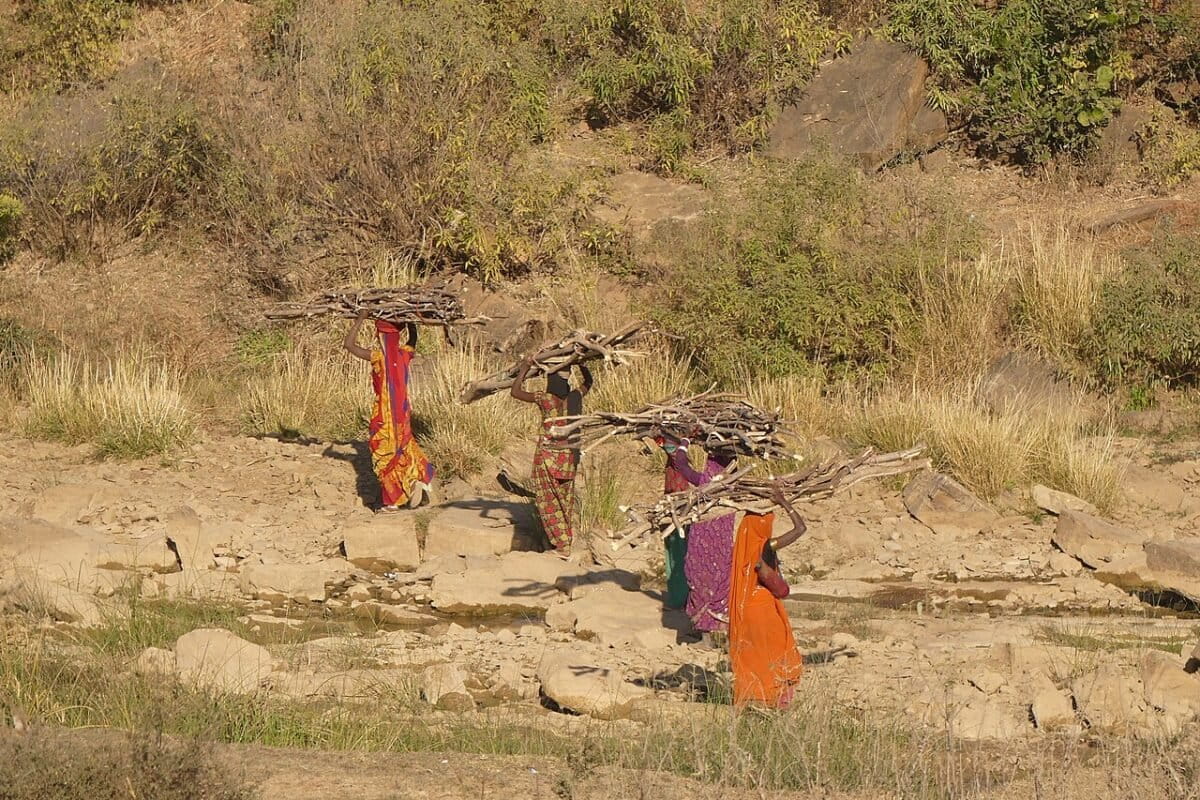
Chandni, a 32-year-old mother of four from Bhalaswa, and a recipient of the PMUY subsidy, enjoyed an uninterrupted gas supply for a year and a half till a month ago. When her refill never came, she returned to a fuel source that proved — in her opinion — more steady and reliable than LPG: firewood. “I’m tired of running from here to there for gas. To what lengths should I go to get my cylinder refilled when I have four children to take care of?” she asked.
The prices of firewood have doubled in Delhi, costing ₹20 a kilo compared to ₹10 before, she said. “Before using LPG, we would stock 30-40 kg of firewood for the week. Since this shortage began, we neither have gas, nor enough firewood. Cylinders are selling for double the price in the black market. Each source of fuel has become more expensive, and we’re scrambling to buy enough wood to get by,” Chandni said.
Bottlenecks in LPG supply
The reach and scale of India’s domestic LPG network is what makes the current scenario challenging. India has around 332 million active domestic LPG connections, of which 104 million are under the PMUY scheme. Most connections are in urban areas, where the impacts of the ongoing crisis are being felt disproportionately.

On March 17, the government put out a statement saying no dry-outs had been reported in LPG distributorships in the country. Two tankers carrying 92,712 million tonnes of LPG — one day’s supply — successfully docked in India after crossing the Strait of Hormuz, but 22 other vessels continue to be stranded in the Persian Gulf.
Even though India has ramped up its LPG production by 38%, the output of this effort is unlikely to bridge the gap. “The yield of LPG from crude processing is relatively low, typically around 1-4% of crude processed. This means that refineries cannot simply increase LPG output without also increasing production of petrol and diesel. And while India is a net exporter of petroleum products overall, refineries are optimised for a fixed product mix, so processing more crude does not allow India to selectively produce more LPG,” explained Sunil Mani, Policy Advisor at IISD.
Commercial establishments are absorbing the initial shock of the supply crunch. But among urban households, it’s PMUY beneficiaries like Chandni that are most vulnerable to falling through the cracks. Even within Delhi, it’s in the lower-income neighbourhoods like Paharganj where stocks of firewood are flying off the shelves. “In the eight years I’ve worked in this shop, I’ve never seen such a sudden demand for firewood,” said Subhash, a worker at the Giridhar Mal Tara Chand, a small firewood supplier.
In the upscale Lodhi colony, sales haven’t surged as Neelam Maini, a firewood shopkeeper, had hoped. “People must be using electric stoves to get by,” she said.
Keeping the stove running
Studies have shown that expanding LPG networks have led to multiple co-benefits, including improved health outcomes for women. In Jharkhand, the adoption of LPG among rural households correlated with higher green cover from 2016 to 2020, suggesting the PMUY had a noticeable effect in promoting “responsible ecosystem stewardship.”
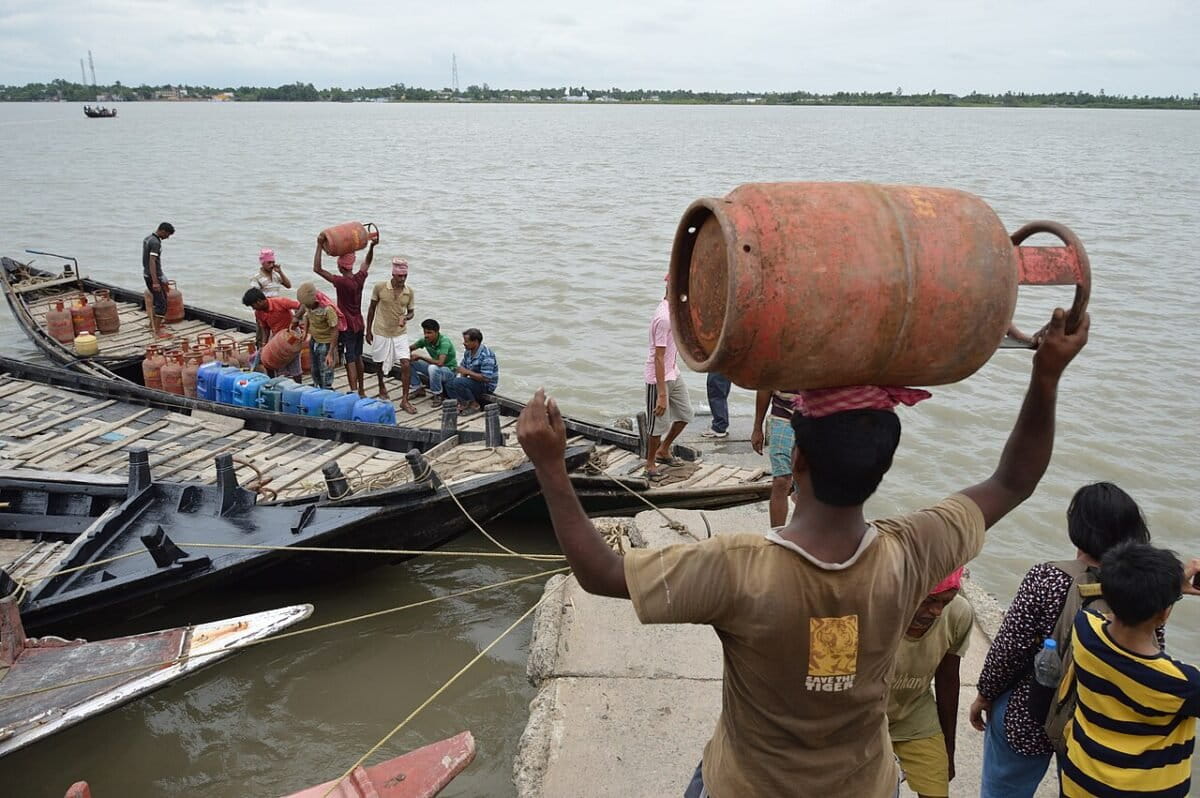
“Unfortunately, it’s the poorest communities who will find it easiest to move back to chulha and firewood, even though it is no longer a behaviour or demand issue,” said Neha Saigal, a consultant with Asar Social Impact Advisors. “If this situation sustains, supply to rural areas, where last-mile delivery was always a problem, may be further weakened. Affordability could price out LPG users in urban areas,” she added.
Around 49% of the population depends on firewood as their primary source of fuel. According to the Forest Survey of India, 85.29 million tonnes of fuel wood are estimated to be removed from the recorded forest areas of the country annually, with the highest quantities reported from Maharashtra, Odisha, and Rajasthan.
The Commission for Air Quality Management removed curbs on burning firewood and coal in the National Capital Region as a temporary measure, till LPG supplies are restored. Shahir Ali, a wholesale firewood supplier from Bhopal, said he’d observed a greater demand for firewood from newer groups of customers — like hostels struggling to feed hundreds of students. “I source my supplies from the Madhya Pradesh forest department’s depot. The situation has left everybody frustrated, and I’m struggling to transport my wood to customers on time.”
Karnataka’s forest minister Eshwar Khandre, on the other hand, issued a stern warning to forest circles within the state instructing them to intensify patrolling to prevent illegal tree cutting in light of the ongoing LPG shortage.
Not all states and regions share this experience, however. “So far as the forest department is concerned, we haven’t experienced any change in the demand or supply for firewood. Auctions are taking place as they were,” said Sanjeev Gaur, Maharashtra’s PCCF for production and management. In Odisha too, Prem Kumar, an IFS officer and managing director of the Odisha Forest Development Corporation (OFDC), said there was no increase in demand for firewood, and declined to comment further.
Diversifying sources and consumption
Both Mani and Saigal agree that the disruption in LPG supply is an opportunity to invest in alternative sources of domestic fuel. “The most viable pathway is a gradual but decisive shift toward electric cooking, particularly in urban and peri-urban areas where grid infrastructure is relatively stronger,” said Mani.
As of 2021, only 5% of Indian households relied on electric cooking devices, mostly to supplement LPG use.
According to IISD’s report on clean cooking, households from Punjab, Rajasthan, and Uttarakhand, which switched to biogas reported a 70% decrease in firewood usage. Biogas is produced from the anaerobic digestion of organic waste. They also reported minimal maintenance challenges and found biogas to be as efficient as LPG, with an identical cooking time.
For both electric cookers and biogas plants to take off, considerable support is needed from the government in terms of subsidies and awareness. “Diversification does not mean replacing LPG or PNG overnight. It means building a more balanced and shock-resistant cooking energy ecosystem that protects low-income households, supports fiscal stability, and strengthens India’s long-term energy security in an increasingly uncertain global environment,” added Mani.
(Published under Creative Commons from Mongabay India)