Madhav Gadgil: The Hub Of A Wheel, The Voice Of The Ghats
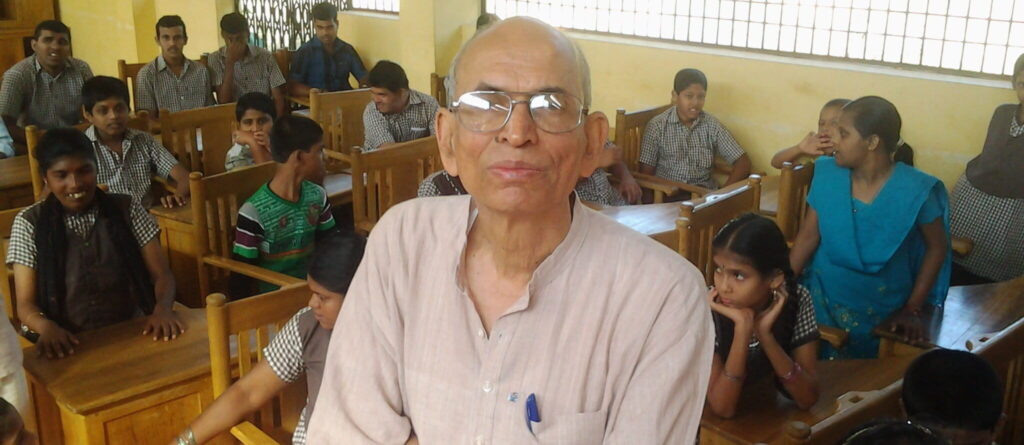
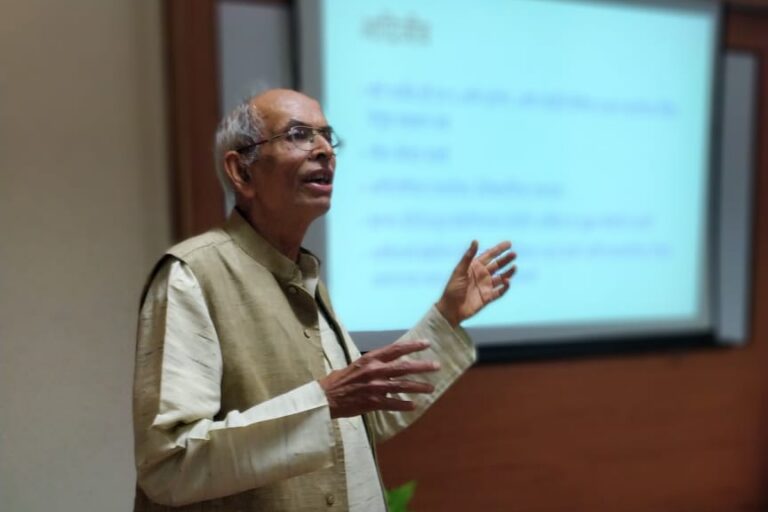
Madhav Gadgil at a school in Kasargod, Kerala (Image by Harish Vasudevan via Wikimedia Commons)
- Through his interactions with Madhav Gadgil from the 1980s to 2020, the author reflects on the late ecologist’s role in influencing India’s environmental conservation efforts.
- Gadgil was a believer of the people’s power. Much of his work was carried out in Kerala, which inspired his thinking on decentralised biodiversity governance.
- During his time chairing the Western Ghats Ecology Expert Panel, Kerala’s priorities had shifted, and his approach was widely criticised and debated.
On the morning of January 8, as I walked along a beach in Kozhikode with my wife, Ramachandra Guha called with the news of Madhav Gadgil’s passing. He asked whether I might speak about Madhav’s relationship with Kerala — and, inevitably, about Madhav and me. My first instinct was hesitation. Surely there were many who stood closer to him.
Madhav had the rare gift of drawing people. Through a call, a letter, an invitation, or a challenge, he would momentarily pull you closer. When the moment passed, you were left altered by the encounter. I was fortunate to be drawn in more than once.
My first such moment came in 1988 at a workshop in Bengaluru organised by our late friend Paul Kurian. It was there that I encountered Madhav alongside Joan Martinez-Alier and Ramachandra Guha. I was then a reluctant academic, working on political ecology in fisheries. My paper on energetics and the marine commons found unexpected resonance with Madhav and Joan, and their encouragement mattered deeply. That workshop also seeded key collaborations between Madhav, Joan, and Ram Guha, that would later shape Indian and global environmental thought.
Our interactions continued sporadically but meaningfully. In 1989, Madhav invited me to a deliberation in Bengaluru as part of Prime Minister Rajiv Gandhi’s Science Advisory Council. We discovered shared concerns — particularly about bottom trawling as an ecologically destructive technology unsuited to tropical seas, regardless of who owned the boats. In 1994, he unexpectedly asked me to accompany him to Geneva for a global meeting on socio-ecological resilience. I realised too late that his expectations of my role exceeded my capacities, a disappointment I have always carried. Yet that journey revealed the immense respect he commanded internationally and offered glimpses of his personal journey, later told with grace in his autobiography — A Walk up the Hill.
His belief in grassroots governance was practical. In 1996, he asked me to join this work, leading me to articulate a vision for a network of Marine Biomass Councils beginning at the coastal panchayat — an idea born directly from our dialogues.
One of our most memorable conversations occurred years later, entirely by chance, at an airport. I was then working on tsunami rehabilitation in Aceh, Indonesia, collaborating closely with a 400-year-old customary fisheries institution. Madhav and I spoke at length about grassroots governance and the role of customary institutions in ecological restoration. With him, conversations were never confined to place or time; they simply resumed where they had last paused.
Our final exchange came in 2020. After I sent him an article on lessons from the ocean in a post-COVID-19 world, he responded warmly — and sharply — attaching a note criticising crony capitalism and ending with a mandate: “People like you should lead a struggle along with the fishing community against the port coming up in Vizhinjam.” That message helped catalyse a people’s report on the port’s impacts, released in 2023 by Ram Guha. In 2025, a simple WhatsApp message arrived in Malayalam: Onashamsakal.
His early professional engagement with Kerala began in the 1970s, but his deeper connection was forged during the Silent Valley struggle. The intervention of the Kerala Sastra Sahitya Parishad (KSSP), particularly its alternative environmental impact assessment led by M.K. Prasad, captured Madhav’s imagination. Here was science not as expert fiat, but as a collective social practice — rigorous, democratic, and morally engaged.
The Parishad’s slogan, Science for Social Revolution, was a language Madhav already spoke fluently. His participation in the KSSP’s public science parliament in 1980 cemented his faith in people’s power. That faith was vindicated when the expert committee of 1982, of which he was a member, provided the scientific basis for abandoning the Silent Valley project. When Silent Valley became a national park in 1984, it marked a historic moment: perhaps the first time in India that a major development project was halted purely on ecological grounds.
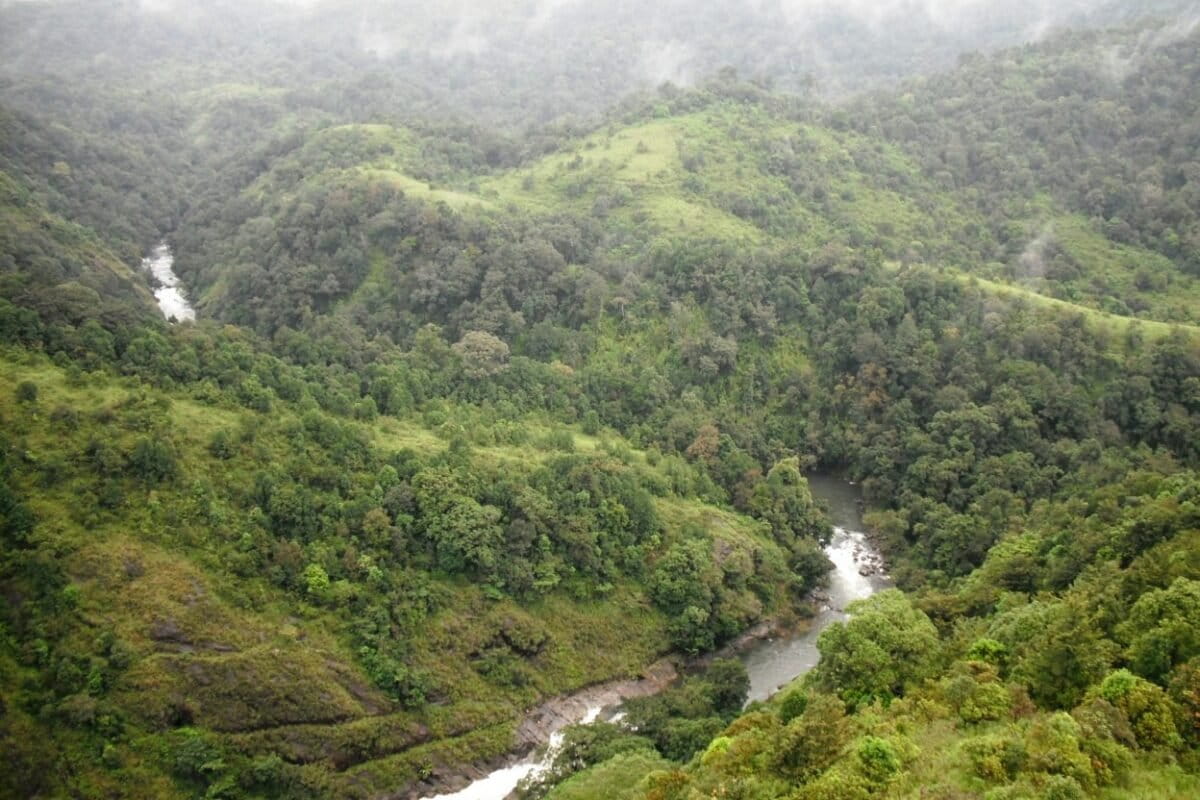
Kerala continued to inspire Madhav’s thinking on decentralisation and biodiversity governance. He worked closely with figures such as M.P. Parameswaran and V.K. Damodaran, and the 1994 workshop at the Integrated Rural Training Centre in Thrissur played a key role in shaping the Western Ghats Biodiversity Network. Its core message — that nature cannot be protected without the people rooted in it — became central to his work.
All this set the stage for his most challenging engagement with Kerala: the Western Ghats Ecology Expert Panel. By 2010, Kerala had changed. Development had become tightly entwined with powerful commercial, political, and religious interests. Public debate had hardened, leaving little space for nuance. The panel’s report was measured, scientific, and democratic. It did not call for shutting down the Ghats, but for graded regulation and genuine devolution of power to local communities. It asked Kerala to slow down — and to think.
Kerala responded with rage. The report was vilified, its recommendations distorted, and Madhav himself personally attacked. Yet in his passing, a deeper truth emerged. Newspapers across Kerala, cutting across ideological divides, carried front-page tributes describing him as guardian, prophet, shade tree, and protector of the Sahyadris.
In which other Indian state would a scientist be mourned so widely?
This is why Madhav Gadgil became a household name in Kerala: not merely because he was celebrated, but because he was argued with — debated in homes, schools, mosques, temples, churches, and legislative assemblies. He became a societal touchstone: a voice one could disagree with, but never ignore.
If India still carries an environmental conscience, it is because voices like his once spoke — and because people took those arguments seriously. Madhav Gadgil was, in the fullest sense, a people’s planetary scientist — a meteor blazing across our sky, leaving behind light, heat, and necessary friction.