India’s Strategic Autonomy For A Capital Lifeline
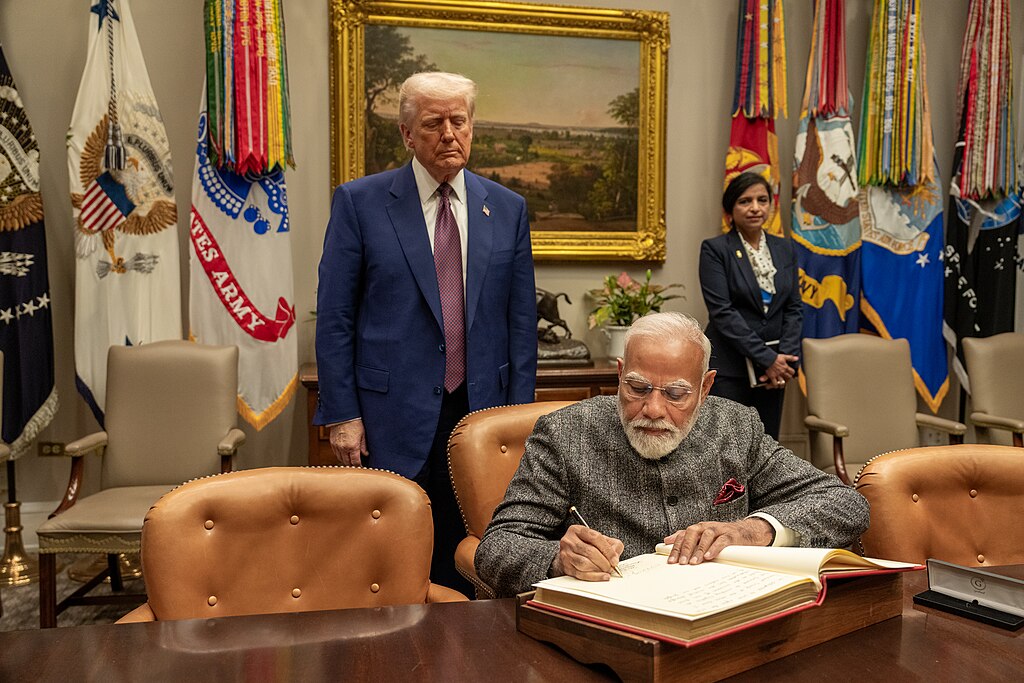
India’s decision to step away from discounted Russian crude reflects a macroeconomic adjustment under constraint (Executive Office of the President of the United States, Wikimedia Commons)
On February 2, a prospective announcement of a to-be-finalised India-US trade agreement arrived with unexpected speed and scope. Tariffs were in principle cut to 18 percent, after a call between US President Donald Trump and Prime Minister Narendra Modi.
A US$ 500 billion purchase and investment commitment was projected as a reset in bilateral ties. Embedded within the agreement, however, was a concession with implications extending far beyond trade. India agreed to stop purchasing Russian oil.
In the event this happens, it may not be a marginal adjustment to trade policy. It intersects directly with the core principle guiding India’s external economic strategy since the early 1990s: strategic autonomy through diversification of partners, energy sources and markets.
The relevant question, therefore, is not whether the ‘final’ agreement can be justified ex post, but why it has become necessary at precisely this juncture.
The answer lies not in diplomatic language, but in the interaction of capital flows, export stress and the limits of diversification that became visible through 2025.
When capital turns before policy
The earliest pressure point did not emerge from trade flows but from the capital account.
For much of 2025, equity markets conveyed resilience. Indices rose steadily, valuations remained firm and headline sentiment suggested continuity. Beneath this surface, however, long-term foreign capital retreated as investors with multiyear horizons reassessed exposure.
The pattern is unambiguous. After modest inflows earlier in the year, net foreign direct investment turned negative from August onward. By October, outflows dominated. On an annual basis, net FDI fell to roughly US$ 353 million, a decline of over 96 percent, while repatriation and disinvestment neared US$ 50 billion.
This shift is structurally significant. FDI is not speculative capital. A contraction at this scale reflects a reassessment of medium-term risk. With portfolio flows volatile and export conditions deteriorating in key sectors, the capital account ceased to function as a stabiliser.
The India-EU trade agreement, while economically meaningful, could not reverse this sentiment in the short term. Capital markets did not question India’s access to European demand. They priced geopolitical alignment, sanctions exposure and long run positioning within a fragmenting global financial system.
What policymakers required was a signal capable of operating immediately across capital markets. By visibly realigning with Washington, even at the cost of energy flexibility, India might reinforce its position with the dominant financial architecture under tightening constraints.
Trade shock
Capital pressure alone does not explain the urgency of the pivot. The second constraint was domestic, which was politically sharper. The impact of US tariff threats was highly uneven across sectors.
At an aggregate level, Indian exports remained relatively stable. Some sectors expanded rapidly. This aggregate performance, however, masked a divergence with significant employment implications.
Telecom instruments, driven largely by electronics and smartphone assembly, recorded export growth of nearly 237 percent. Electrical machinery also expanded. These sectors are capital intensive, dominated by large firms embedded in global supply chains with pricing power and operational flexibility.
Labour intensive exports faced pronounced contraction. Gems and jewellery exports declined by over 40 percent, while textiles fell by more than 22 percent. These sectors employ large numbers of workers, often informally, and are concentrated within specific export clusters. When demand contracts, adjustment transmits rapidly through employment rather than margins.
For these industries, sustained tariffs of 25 percent to 50 percent threatened order flows and firm viability. Evidence of stress emerged well before the agreement was announced, as buyers deferred or cancelled contracts amid prolonged trade uncertainty.
From a political economy perspective, this asymmetry was decisive. Preserving export employment required tariff relief. Tariff relief required concessions. Energy sourcing became the adjustment variable through which that relief was secured. By moving away from discounted Russian crude, India redistributed the cost across the economy through higher energy prices and imported inflation. This reflected a deliberate trade off under constraint.
Exports diversification
A natural counterargument is that India had already begun diversifying its export markets, reducing exposure to the US. The data supports this claim, but only partially.
Marine exports illustrate the pattern. While exports to the US declined by over 17 percent, shipments to China rose by nearly 23 percent, and exports to Belgium more than doubled. Several European markets also recorded strong growth, indicating active search for alternative demand.
Diversification, however, operates on commercial rather than financial time. It is uneven across sectors and does not immediately offset capital account stress or tariff driven employment shocks. New markets take time to scale, and not all export industries pivot with equal speed.
By late 2025, India faced a narrowing policy corridor. Export diversification was real but incomplete. Capital inflows had weakened sharply, while employment pressure in labour intensive sectors intensified. The agreement with the US addressed these constraints simultaneously, albeit at a structural cost.
A US$ 500 billion Buy American commitment re-anchors India’s trade trajectory toward the US, potentially limiting the momentum of the multipolar strategy that had begun to emerge through Europe and Asia. Diversification did not collapse. It was overtaken by financial urgency.
Bringing pressures into focus
Placing these dynamics within a single analytical frame clarifies the logic of the February 2 announcement. The deal emerged from the interaction of tightening constraints rather than a sudden shift in strategic doctrine.
The collapse in net FDI narrowed India’s external financing cushion as trade volatility increased. Export stress was concentrated in labour intensive sectors where adjustment manifests quickly through employment. Diversification offered a credible medium-term response, but not one capable of stabilising the economy on the time horizon policymakers faced.
Under these conditions, the state required a signal capable of influencing capital markets, trade relationships and geopolitical expectations simultaneously. The US was uniquely positioned to supply that signal. The reduction of tariffs to 18 percent, the scale of the purchase commitment and the realignment on energy sourcing collectively reinforced India’s position within the dominant global economic order.
The costs of this recalibration are embedded in the agreement’s structure. Energy security has been exchanged for capital reassurance. Export employment has been protected through an economy-wide inflation channel. Fiscal space has been pre-committed. Strategic autonomy has become more conditional and more explicitly priced.
The decision to step away from discounted Russian crude reflects a macroeconomic adjustment under constraint rather than an ideological rupture. The announcement of a new US-India trade agreement doesn’t inaugurate a new growth model. It manages vulnerability and buys time by committing future policy space. Whether that trade proves prudent depends on how that time is used, and whether the conditions that made the pivot necessary are addressed before the next constraint emerges.
(Published under Creative Commons from 360info.org)