Women Gig Workers Stage Protest, Demand Rights Amid Exploitation
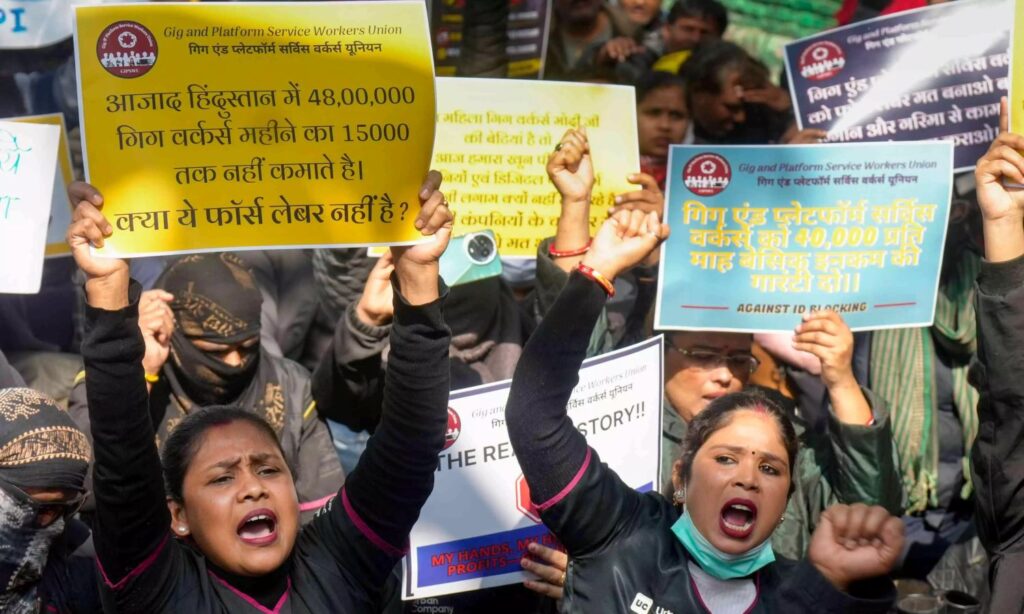
Over 100 female workers protested at Jantar Mantar on February 3 (Photo: PTI)
Over 100 gig workers, predominantly women, gathered at Jantar Mantar in New Delhi recently to voice their grievances against digital platforms. Organized by the Gig and Platform Services Workers Union (GPSIWU), a women-led union, the protest highlighted issues like arbitrary account suspensions, meager earnings, and the absence of basic labor protections. Similar demonstrations were underway in Karnataka, Maharashtra, and Rajasthan, underscoring a nationwide discontent.
By early afternoon, Sunita, a home services worker from Punjabi Bagh, expressed frustration over the financial toll of participating. “I have already lost nearly Rs 900 in daily income by joining the protest,” she said, reflecting the harsh reality of gig work. Initially attracted by promises of flexible hours and steady income, Sunita now lives in fear of unexplained account blocks. “In the beginning, there were many bookings. They said I could manage my family. Now my ID is blocked without any reason,” she alleged.
Another protester, who wished to remain anonymous, shared a poignant story of hardship. Her account was suspended in 2022 after four years with the platform. “My husband died a few months later, leaving me without steady income,” she recounted. She briefly worked as a cook earning Rs 15,000 a month but lost that job when her employer’s family relocated from Delhi. Many women at the protest covered their faces, fearing retaliation from platforms if identified.
Workers accused platforms of inflating deductions that slashed their earnings. Sunita cited a recent booking worth Rs 2,295, where commissions and mandatory charges totaled Rs 1,401. “If we don’t pay the credit amount, bookings stop coming. After working from morning till evening, this is what remains,” she explained, adding that workers were pressured to purchase company products.
Union leaders emphasized that problems extended beyond pay. GPSIWU president Seema Singh criticized the lack of support. “When something goes wrong, there is no human support. Workers who go to company offices in Gurugram are often sent back without solutions. Sometimes they are not even allowed to enter,” she stated. Singh also highlighted safety risks, particularly for women. “All they offer is an AI chatbot. That cannot help a woman facing abuse,” she said, pointing to inadequate responses to sexual harassment and late-night dangers.
A recent survey cited by the union revealed alarming work hours: nearly one in four gig workers in India toil over 70 hours a week, while more than half exceed 49 hours. This protest follows strikes during Christmas and New Year’s Eve in Delhi, where workers protested low pay, unsafe conditions, and stringent delivery deadlines.
The demonstrators demanded formal employee status, fair wages, and protections against arbitrary suspensions. As Sunita put it, “We need recognition as workers, not just freelancers at the mercy of algorithms.” The event highlighted the gig economy’s dark side, where flexibility often masks exploitation, leaving workers vulnerable in an unregulated sector.