Why Does Donald Trump ‘Really’ Want Greenland?
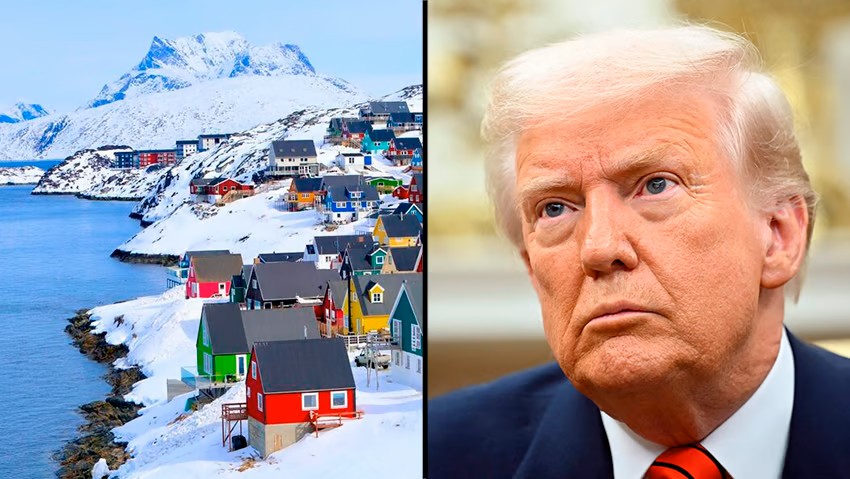
US President Donald Trump may not be interested in owning Greenland per se but is using coercion to pressure the government of Greenland into making economic deals with the US and not with China. Ergo, Trump’s threatening position could have less to do with national security and is more about removing Chinese competition and securing US interests, particularly business ones (Photo: AFP, Chris Christophersen/Shutterstock)
What makes the sitting President of the United States, arguably the world’s most powerful man, want to take over a sovereign nation, giving short shrift to international laws and regulations and the sovereignty of nations?
In his first term, Trump put forth an offer to buy Greenland – which has been a part of Denmark for around 300 years. It was readily rebuffed by both Danes and Greenlanders.
In Trump’s second term, we are witness to this offer turning into a threat. This, despite Greenland being a part of NATO, which provides a collective defence pact, meaning that member nations are bound to respond to an act of aggression or attack on any alliance member.
The pertinent question here is – why is Trump hell bent on taking over Greenland?
The 2025 National Security Strategy of the Trump administration recognizes three threats in the Western Hemisphere – drugs and crimes, migration and the increasing influence of China.
Two of the above threats are irrelevant in the context of Greenland. The residents of Greenland are not drug traffickers and they are not migrating to the United States. However, Greenland is blessed with abundance in rare earth minerals. These include copper, graphite, lithium, neodymium and dysprosium.
The Trump administration has stated clearly that controlling these minerals is a matter of national security; the president also wants to keep them out of the reach of China.
It is germane to mention here that China has sought to set up mining interests in the Arctic and Greenland as part of the Polar Silk Road initiative. It also offered to build infrastructure for Greenland – this includes an airport – until Denmark stepped in and advanced funding for said airport. Additionally, China has worked with Australian companies to bag mining opportunities on the island.
Meanwhile, the rare earth minerals present in Greenland appeal to the European Union as well. Of the 30 raw materials listed as essential for economies in the EU, 25 are in Greenland.
Although figures vary, it is estimated that more than 60% of rare earth minerals or elements are currently mined in China. It also refines around 90% of rare earths. This accords China massive leverage in business talks and causes a risky susceptibility for the US and other nations that seek to modernize their economies. With the number of suppliers of these rare earth minerals being very limited, the economic and political costs of securing them remain high.
Importantly, there are only two operating mines in Greenland. Out of these, the Tan Breez project in southern Greenland produces 17 metals, including neodymium and terbium; these are used for producing high-strength magnets used in aircraft manufacturing, including for the F-35 fighter planes; they are also used in many green technologies.
It could be a stretch of the imagination but let’s contemplate for a moment that Trump is not interested in owning Greenland but is using coercion to pressure the government of Greenland into making economic deals with the US and not with China. Ergo, Trump’s threatening position could have less to do with national security and is much more about removing Chinese competition and securing US interests, particularly business ones.
Such iron-fisted diplomacy puts at risk the economic and political development of not just Greenland but entire Europe. In several interviews he has given recently, Trump has implied clearly that he has no respect for the sovereignty of nations and international law. Trump’s position, by undermining the international order, makes the US no longer as beholden to the framework set up after the Second World War.
US history in Greenland
The United States has tried to buy Greenland from Denmark several times in history.
In 1867, U.S. Secretary of State William Seward sent surveyors to Greenland. He liked its natural resources and wanted to buy Greenland and Iceland for $5.5 million (about $125 million today). But the US Congress said no. They were still upset about buying Alaska that same year for $7.2 million (about $164 million today), which Seward had also pushed for. People thought Alaska was too cold and far away, and they didn’t want another icy land.
In 1910, the U.S. ambassador to Denmark suggested a complicated trade. Denmark would give Greenland to the U.S., and the U.S. would give some Philippine islands to Denmark. Denmark would then give those islands to Germany, and Germany would give back the region of Schleswig-Holstein to Denmark. But the U.S. decided this idea was too foolhardy and dropped it.
During World War II, Nazi Germany took over Denmark. The U.S. stepped in to protect Greenland and Iceland, which belonged to Denmark. The U.S. built airstrips, weather stations, and radar sites — five on Greenland’s east coast and nine on the west. They used these places as bases for bombers attacking Germany. Greenland was important because of its spot in the North Atlantic, helping protect shipping routes and refuel planes. It also had cryolite, a mineral used for making aluminum.
In 1946, President Truman’s government offered $100 million to buy Greenland. U.S. military leaders saw it as key for the Cold War. A secret project called Operation Blue Jay built Thule Air Base in northwest Greenland, letting U.S. bombers get closer to the Soviet Union. Today, it’s called Pituffik Space Base and helps with missile warnings and space watching for NATO and U.S. security.
After World War II, Denmark officially made Greenland one of its territories. In 1953, Greenland got constitutional rights and became a country within the Kingdom of Denmark. It gained self-rule in 1979 and became fully self-governing in 2009, still part of the Kingdom (which includes Denmark, Greenland, and the Faroe Islands).
Denmark treats Greenland’s government as an equal partner. Recently, Denmark gave Greenland a bigger role as the main voice for Denmark in the Arctic Council, which helps countries work together in the Arctic.