Elephant Deaths On Railway Tracks Expose Gaps In Wildlife Safety
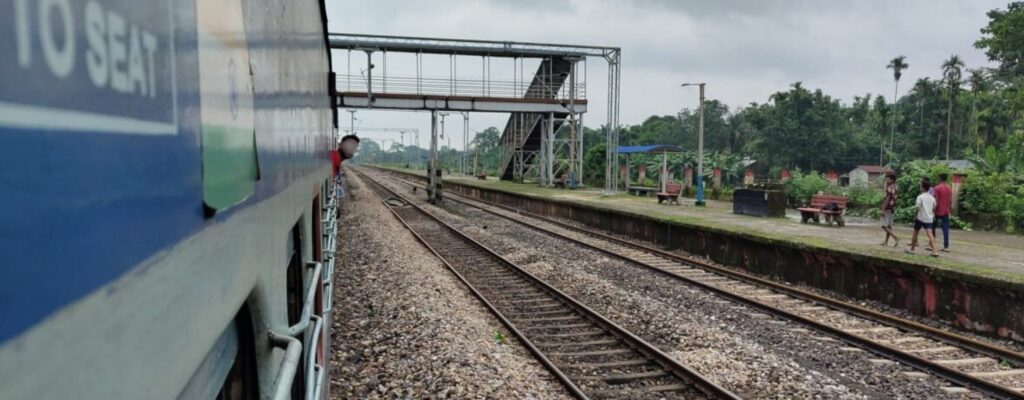
A train station in Assam. Experts say that elephant–train collisions are not new to people in the Kampur subdivision in Nagaon. In 2016, four elephants were mowed down by a train, close to the spot of the recent accident (Representative image by Himanshum14 via Wikimedia Commons)
- On the night of December 20, eight elephants were killed after collision with a superfast train in Assam.
- Though not a notified corridor, the stretch where the accident occurred has long seen regular elephant movement, especially during winters, the local residents note.
- While low visibility during winters increases the risk of accidents, there is a need for improved coordination between the forest department and railway authorities, and stricter mitigation measures.
On the cold, foggy night of December 20, eight elephants — three adults and five calves — were killed after colliding with the superfast Sairang–New Delhi Rajdhani Express in the Jamunamukh–Kampur section under the Lumding division in Assam. This includes a new born calf, delivered on the track from the impact of collision. The impact was so severe that five bogies of the train, along with the locomotive, were derailed. However, no human deaths or injuries were reported.
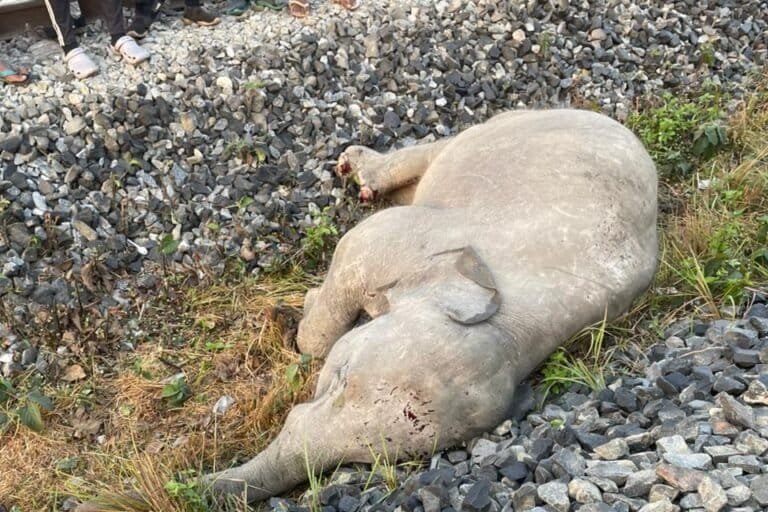
The incident occurred near Sangjurai and Patiapam, villages under the Kampur subdivision in Nagaon district, around 126 km from Guwahati.
According to a statement released by Kapinjal Kishore Sharma, Chief Public Relations Officer (CPRO) of Northeast Frontier Railways (NFR), other trains such as the Rangiya–New Tinsukia Express, Guwahati–Jorhat Town Jan Shatabdi Express, Guwahati–Badarpur Vistadome Express, and New Tinsukia–Rangiya Express, were cancelled that day, following the incident.
Expressing regret over the incident, Assam Chief Minister Himanta Biswa Sarma ordered a thorough enquiry. Meanwhile, the state forest minister Chandra Mohan Patowary told media persons: “The PCCF (Principal Chief Conservator of Forest) and HoFF (Head of Forest Force), Assam and PCCF (Wildlife) and CWW (Chief Wildlife Warden), Assam have been directed to take up the matter with the senior-most officials of Indian Railways to prevent the recurrence of such tragic incidents in the future.”
New route for elephants?
In a statement, Northeast Frontier Railways (NFR) said that the accident location was not part of any designated elephant corridor. There are nearly 80 designated elephant or animal corridors within the zone, which covers eight northeastern states and parts of Bihar and West Bengal. The statement further said that after spotting a herd of around 100 elephants, the locomotive pilots applied emergency brakes, but the elephants dashed into the train.
However, elephant movement has been noticed in the area for a long time, said Molan Laskar, a social activist based in Kampur town, located at about 10–12 km from the accident site. “So, even if this is not a notified corridor, trains should slow down here.” He added that after the incident, the railway department provided helpline numbers for people to report elephant movement along railway tracks. “Had they done this earlier, the incident could have been averted,” Laskar told Mongabay-India.
Two agrarian villages — Sangjurai and Patiapam — known for rice cultivation, are frequently visited by elephants, according to the village residents. They claim that elephants come from Kondoli Reserve Forest to their villages during winter to graze on paddy.
Patiapam resident Anil Baruah, who lives just a few hundred metres from where the accident occurred, said, “The railway track here, from colonial times, cuts through our village and abuts the neighbouring village of Sangjurai. Elephants are commonly seen feeding on paddy here during November–December.”
He continued, “I have also heard that some elephants come from Kaziranga National Park to deliver their calves to avoid predation from tigers. There is an abandoned compound of a sugar mill that was shut 15–16 years ago. That place is now a grazing reserve for cattle in nearby villages. Elephants use that forest for shelter during the winter.”
Baruah added that elephant–train collisions are not new to people in the area. “In 2016, four elephants were mowed down by a train, around a kilometre from the spot where the recent accident happened.”
Lack of coordination
Meanwhile, the forest department has claimed that despite informing the railway authorities in time, the incident could not be prevented.
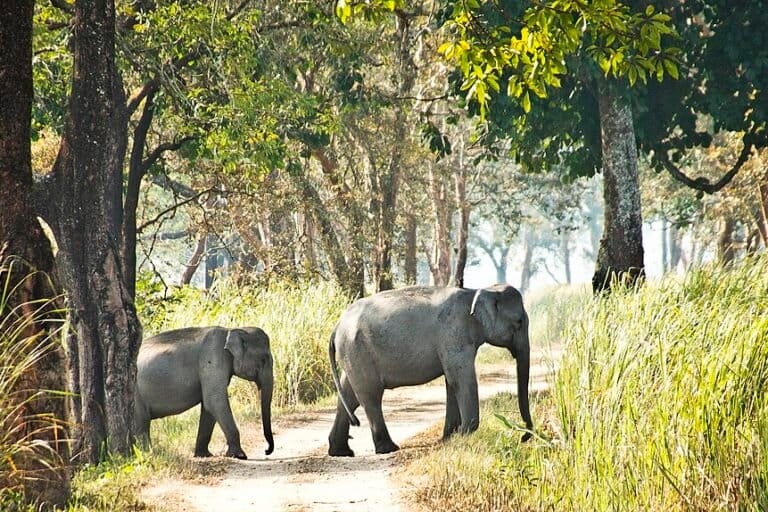
In a telephonic conversation with Mongabay-India, Shamim Akhtar, Range Officer of the Kampur range, said, “Our forest guards patrolling at night tracked the movement of a herd of more than 60 elephants at around 1.30 a.m. The elephants had already crossed the Kathiatoli range by then and had entered Kampur. Though we have a WhatsApp group with the NFR for coordination, we didn’t take any chances. Our staff went and alerted the station master at Kampur station. Despite that, the accident happened at around 2.30 a.m.”
She added, “We seized the engine of train number 20507 and booked the two locomotive pilots for more than 12 hours before they were released. During the interrogation, the locomotive drivers told us that the train was running at a speed of more than 100 km per hour.”
Akhtar also pointed out that the deceased elephants were not residents of Kampur. “In my range, there are no reserve forests. These elephants live in Doboka Reserve Forest or Kondoli Reserve Forest in the Kathiatoli range, which is about 10 km from Kampur. While this is not a designated elephant corridor, there is constant movement of elephants from Hawaipur to Kampur during winter when they come in search of food.”
Talking about low visibility due to heavy fog during winter, Akhtar noted that it increases the chances of accidents. “However, our guards remain alert during the season, and we have also formed an anti-depredation squad with local village residents. With their help, we have managed to avert many accidents in the past,” she added.
Mitigation measures
There are three vulnerable divisions — Tinsukia, Lumding and Rangiya — where elephants face the risk of colliding with trains while crossing tracks, said Anupam Sarmah, team leader of the Brahmaputra landscape, WWF-India. The sharp turns and hilly terrain in these stretches often make visibility difficult for locomotive pilots, he explained. “Most of these accidents happen during winter when visibility is reduced due to fog. We try to conduct regular awareness sessions with locomotive pilots,” he said.
Mitigating such incidents is possible by strictly following speed instructions, Sarmah added. “Some areas have permanent speed breakers, while others have temporary ones. It is important to adhere to these speed restrictions. Patrolling needs to be tightened in vulnerable areas, and better coordination is required between the forest department and railway authorities. We have to remember that the world around elephants is changing, and we cannot expect them to follow only designated corridors.”
In an official statement, the Northeast Frontier Railways claimed that in 2025, 160 elephant lives were saved through mitigation measures. “A major step in this direction is the deployment of the Intrusion Detection System (IDS), an advanced artificial intelligence-based technology utilising Distributed Acoustic System (DAS) principles. The system detects elephant movement near railway tracks and instantly provides real-time alerts to loco pilots and control rooms, enabling timely preventive action and enhancing operational safety,” the statement said. However, the IDS was not installed in the Sangjurai-Patiapam area.
The statement further said that the NFR has taken other measures to reduce train–elephant interactions, such as the “Plan Bee” system installed at vulnerable level-crossing gates, which uses amplified honeybee sounds, audible up to 400 metres, to deter elephants from approaching railway tracks.