Unnao Rape Case: A Terrible Day For Women In India
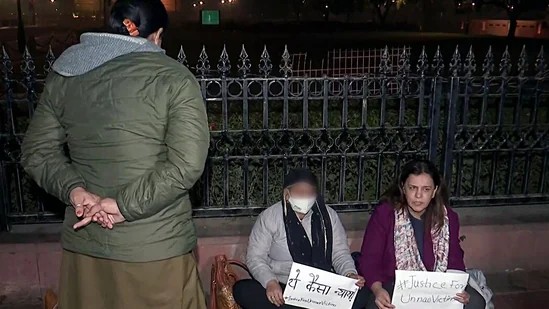
Women's rights activist Yogita Bhayana and the Unnao rape survivor hold a protest against the Delhi High Court's order suspending the sentence of 2017 Unnao rape case accused Kuldeep Singh Sengar at India Gate in New Delhi (ANI Video Grab)
“I am hurt that such a judgment has been passed. This is the first order in the country where a rape accused has been granted bail, and the sentence has been stayed…” These are the words of the 2017 Unnao rape case survivor.
Her anguish is palpable as she reacted to the news that Kuldeep Singh Sengar, former BJP MLA, has been granted bail by the Delhi High Court.
Although the Central Bureau of Investigation (CBI) has said that it will file a Special Leave Petition (SLP) in the Supreme Court to challenge the Delhi HC’s order granting Sengar bail in the 2017 Unnao rape case and suspending his life sentence, questions are being raised over the manner in which Sengar was granted bail in the first place.
“What was the CBI doing before?” asked the rape survivor, while also levelling allegations of collusion between the CBI and the accused. “The CBI’s IO has met with Kuldeep Sengar,” the rape survivor said.
This development underlines the way rape survivors are viewed and treated in India. The granting of bail to Kuldeep Sengar reveals a systemic failure in delivering justice to rape survivors in this country.
The Unnao rape survivor has expressed fears for her own and her family’s safety now that the monster who violated her has been given bail.
“He is a powerful man. He would get his men to do his dirty work for him. When my car met with an accident in which two of my relatives and my lawyer died in 2019, Sengar didn’t do it himself. His henchmen did. Now that he is out, we are all unsafe,” the survivor said.
While granting bail to Sengar, the HC directed that he must not enter the five km area in Delhi where the victim resides, that he shall remain in Delhi and shall not contact the family members of the victim.
Seventeen at the time she was violated, the rape survivor’s apprehension for her safety is rooted in reality. UP minister Om Prakash Rajbhar, citing the court’s directives over Sengar’s bail – including asking him to stay atleast five kms away from the survivor’s family – was quoted as saying by news agency ANI, “While protesting in Delhi, the police told the family that if the court has made this arrangement, then how can they be unsafe?”
This comment, the only one currently made public, reveals the mindset of a serving minister in the UP government about a rape survivor. Predictably, if this is the mentality of a government official, one can only wonder – with a shudder – how a layman with no fear of law or probity would think and act.
The latest developments in the Unnao rape case reveal systemic inadequacies and point at deep-rooted misogyny in our country. Attempts to pin the blame of the crime on the victim herself is not unheard of; the way women are then subjected to intrusive and objectionable questioning in the courts is reprehensible but much too common. Ultimately, even after finding a rape accused guilty, there are many loopholes available to evade justice or lessen the severity of the punishment.
Unfortunately, some women also enable such behaviour and must share part of the blame.
Meanwhile, a criminal will be free to exercise his freedom and enjoy the perks of citizenship even as the woman he defiled lives in fear of retaliation towards herself and her family. This is certainly enough to make Indians collectively hang their heads in shame.