Yamuna Pollution: NGT Directs UP Chief Secy To Clean Up
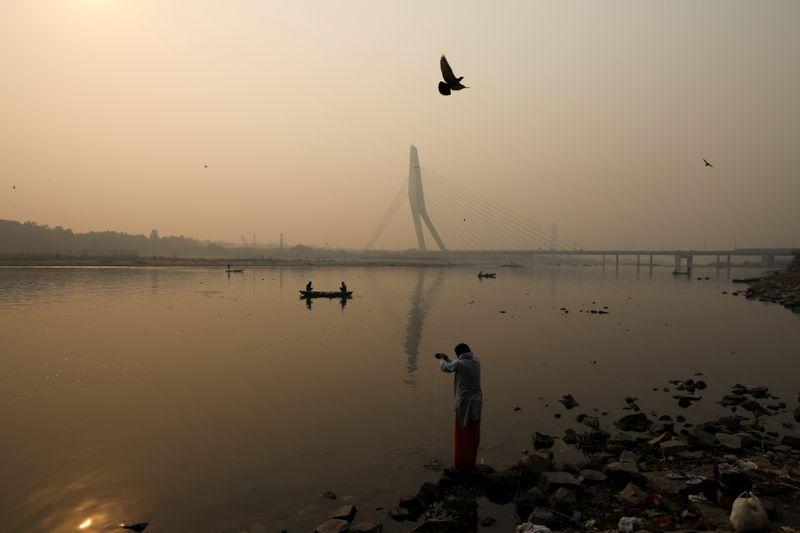
FILE PHOTO: A man prays on the banks of the Yamuna river on a smoggy morning
Source: PTI
The National Green Tribunal (NGT) has directed the Chief Secretary of Uttar Pradesh to ensure remedial action in matters pertaining to pollution of the river Yamuna in Mathura and Agra.
The NGT was hearing two applications on the pollution of the river. The applications alleged discharge of untreated sewage into the Yamuna in Mathura and pollution of the river in Agra by local authorities, private businesses and commercial establishments.
A bench chaired by Justice A.K. Goel noted that, in pursuance of the tribunal’s earlier orders, the state pollution control board (PCB) had filed separate reports acknowledging the pollution of the river Yamuna, including the discharge of 131 million litres per day (MLD) of untreated sewage into it in Mathura and the failure of the authorities to take necessary remedial action in Agra.
The bench, also comprising judicial member Justice Sudhir Agarwal and experts A Senthil Vel and Afroz Ahmad, noted the discharge of untreated sewage into the river in Mathura, and added that there were “huge gaps and deficiencies in sewage management” in Agra.
“In view of the fact that Mathura is a heritage city of great significance, visited by a large number of persons, urgent measures are called for, particularly by senior-level officers, since huge funds stand allocated for the purpose without adequate results on the ground,” the bench said.
The bench also noted that, according to the report, there were three untapped or partially tapped drains in Mathura, while out of a total of 13 drains in Vrindavan, two were still untapped, and there was no schedule for the interception of such drains.
“Further, polluted water is being discharged into the rivers which are supposed to carry potable water. The channel for sewage or other effluent treated or untreated should be separated and treated water used for non-contact purposes, including agriculture, horticulture and industries, and supply of such water to Mathura refinery may also be explored,” the bench added.
Regarding the sewage management in Agra, the bench noted that out of the 286 MLD of sewage flowing into the drains, only 58.25 MLD was tapped and no information was provided about the wastewater in the sewage network. Though the installed capacity of nine sewage treatment plants (STPs) was 220.75 MLD, their capacity utilisation remained at 175 MLD.
“Treated sewage is still being discharged into [the] Yamuna instead of its utilisation. There appears to be no urgency for providing STPs,” the bench said.
The green panel directed the state’s chief secretary to ensure remedial action in the two cities, by convening a meeting with the officers concerned within a month. The officers are to plan within two months for the interception of untapped drains and their diversion to the STPs, the tribunal has required.
The bench has also asked the officers to ensure that treated sewage from each STP is provided to the identified command area for irrigation or agriculture, that only during the non-utilisation period should treated sewage go to the river and that the performance of the six STPs be evaluated and improved and their mode of disposal defined.
The tribunal also directed the officers to study the chlorination method and treatment of industrial effluents.
With respect to Agra, the tribunal asked the officers to look into the full utilisation of the existing nine STPs and ensure that the treated effluents are used for secondary purposes.
The bench also directed consideration of other aspects, including interception of partially tapped drains and their diversion to STPs, evaluation of the performance of in-situ projects and fortnightly monitoring of existing treatment of waste water with reference to consent conditions.
The tribunal also directed the Central Pollution Control Board (CPCB) to file a report on chlorination, ferti-irrigation, performance of STPs and in-situ remediation projects in Agra.
The tribunal ordered the filing of reports within four months, detailing action taken. Further proceedings are scheduled for August 23.